Showing posts with label Starters / Entradas.. Show all posts

11 October 2017

Burrata with burnt Oranges, Pistachios, Mint and Pomegranate / Burrata com Laranjas queimadas, Menta e Romã.


Delicious little sharing "salad" type plate, from Sabrina Ghayour new book "Feasts" and one that fits perfectly into this month's "Marta's ingredient of the month" which is, pomegranate!!
I truly adore Sabrina's books and this last one, "Feasts" is a real delight.
Full of colorful and delightful recipes and the type of book that makes you go to the kitchen and cook the book off!
This salad was the first recipe I prepared form the book. Not just because I'm mad about Burrata, but also because all the ingredients and colours combination was screaming "PREPARE ME"!!
This plate is not, just easy and quick to prepare, but it's also a great combination of flavours and textures.
As soon as I saw that Marta chose pomegranate as the ingredient of the month, I knew that this gorgeous plate would be a winner at her monthly table and here it is!


16 March 2017

Jerusalem artichoke Blinis topped with blue cheese / Blinis de Girassol batateiro com queijo azul.


You know I'm a huge Jerusalem artichoke lover. If you look up at the "Jerusalem artichoke" label here on the blog, you'll find loads of recipes with this amazing ingredient.
Every year, as soon as they are in season and I find them, I can't resist buying a whole lot of them.
This recipe, featured in the absolutely gorgeous book "The Modern Vegetarian", from the very well known Chef Maria Elia, is a true stunner!!
Just try to make it and serve it as a starter at a dinner party and your guests will love you forever!!
Honestly, although it looks very posh and labour intense, it's so, so easy to make that the smiles on your guests faces will be the best reward you'll get for such little work.
You can make the blinis in advance and gently reheat them in the oven before serving. As for the cheese, if you don't like blue cheese, you can use other kind of cheese, like pecorino, goat's cheese, manchego or other cheese you like.
If you don't like Jerusalem artichokes, you can use parsnips or none, if you don't like either of them, and use just potatoes.

10 February 2017

Scallops, Chorizo and Rocket / Vieiras, Chouriço e Rúcula.


Scallops, chorizo and rocket!
A fabulous combination of flavours and textures, easy to put together and so, so delicious!!
A combination that one day, I put together by accident and that turned out being amazing and a staple in our household.
I'm sharing this suggestion with you all today (with a more refined presentation than the one we use to have at home), just because I think it's a very special combination and "THE" perfect Valentine's Day starter to share with your person.

20 July 2015

Cured citrus salmon / Salmão curado com citrinos.


Cured salmon or gravlax is one of the most loved ways of eating it here at home.
Everybody loves it, even the kids and although I never posted it here on the blog (never liked the photos that I took), I use to make it very often and our Christmas Eve starter is always cured salmon.
As all of you know by now, I really am a citrus lover and therefore, as soon as I saw this recipe, I couldn't rest until I tried it and it is so worthy!!
ingredients (serves 8):
finely grated zest of 1 large orange
finely grated zest of 2 limes
finely grated zest of 1 unfazed lemon
1 tbsp sea salt flakes
2 tbsp golden caster sugar
1 tsp juniper berries
1 tsp black peppercorns
1 tsp fennel seeds
1/2 tsp coriander seeds
1 star anise
4 tbsp dill, finely chopped
around 1 kg of 1 whole filleted side of salmon, skin on, scaled and pin boned


method:
Cover one tray with a triple thickness of clingfilm, leaving plenty of excess draping over the sides.
Mix the grated zests with the sea salt flakes and sugar.
Using a pestle and mortal, lightly crush the juniper berries, peppercorns, fennel and coriander seeds. Add this combination to the salt mix.
Break the star anise into small pieces and coarsely grind, then add to the salt mixture with 2 tbsp of the chopped dill and mix well.
Scatter 1/3 of the salt mixture over the clingfilm-covered tin.
Lay the salmon on top, skin-side down, and cover with the remaining salt mixture, pressing it into the fish with your hands. Tightly wrap the salmon in the clingfilm and cover with another tray.
Put some weight over the second tray and put the trays in the fridge.
Leave the salmon to cure in the fridge for 48 hours.
Unwrap the salmon, wash of the salt mixture from the salmon and pat dry with kitchen paper. Scatter the salmon with the remaining chopped dill and cut into thin slices with a sharp knife.
Serve with rye bread, salad or lightly pickled vegetables.
__________________


Salmão curado, ou Gravlax, é muito apreciado cá em casa. Embora nunca tenha publicado aqui nenhuma receita no blogue, faço-o muitas vezes e no Natal é sempre a nossa entrada do jantar de Consoada.
Tenho uma receita do tradicional gravlax nos rascunhos do blogue (que ainda há-de ser publicada um dia destes e só não o foi ainda, porque as fotos não estavam em condições), desde Fevereiro, pois o meu filho, o mais louco de todos por gravlax, foi o que pediu para o almoço no dia dos anos dele. Quem me segue no instagram, já por lá viu (nos primórdios da minha adesão a essa rede social), fotos em que estou a curar o salmão.
A forma tradicional de curar o salmão para o gravlax, é com sal, açúcar e endro.
Hoje em dia há imensas variantes e sabores de cura e esta, com citrinos, sendo eu uma citrinos lover, assim que a vi, não podia deixar de a experimentar.
ingredientes (para 8 pessoas):
raspa de 1 laranja grande
raspa de 2 limas
raspa de 1 limão biológico
1 colher sopa de flocos ou flor de sal
2 colheres sopa de açúcar refinado amarelo
1 colher chá de bagas de zimbro
1 colher chá de grãos de pimenta preta
1 colher chá de sementes de funcho
1/2 colher chá de sementes de coentros
1 estrela de anis
4 colheres sopa de endro, picado muito finamente
1 lado de salmão, com cerca de 1kg, com pele, escamado e sem espinhas


preparação:
Cobrir um tabuleiro com 3 camadas de película aderente, deixando bastante película suplente acima da bordadura do tabuleiro.
Numa taça, misturar as raspas dos citrinos, o sal e o açúcar.
Num almofariz, esmagar ligeiramente as bagas de zimbro, os grãos de pimenta e as sementes do funcho e dos coentros.
Adicionar esta mistura, à mistura dos citrinos e do sal.
Partir a estrela de anis em bocados e esmagá-la grosseiramente no almofariz.
Adicionar a estrela de anis esmagada e 2 colheres sopa de endro picado à mistura anterior e misturar tudo muito bem.
Espalhar 1/3 da mistura de citrinos e especiarias no fundo do tabuleiro.
Colocar o salmão sobre a mistura, com o lado da pele virado para baixo.
Cobrir a parte superior do salmão com a mistura de citrinos restante.
Embrulhar muito bem o salmão na película aderente.
Colocar um tabuleiro vazio sobre o salmão e sobre este, colocar pesos tipo, latas de conservas ou algo do género.
Colocar os tabuleiros no frigorífico e deixar o salmão curar por cerca de 48 horas.
Findo esse tempo, desembrulhar o salmão e lavá-lo rapidamente com água fria corrente, por forma a limpá-lo dos ingredientes da cura.
Secar bem o salmão com papel absorvente de cozinha.
Colocar o salmão num prato ou tábua de serviço, polvilhar com o restante endro picado e servir em fatias muito finas, acompanhado com pão de centeio, salada ou pickles de legumes.


Recipe / Receita:

26 June 2015

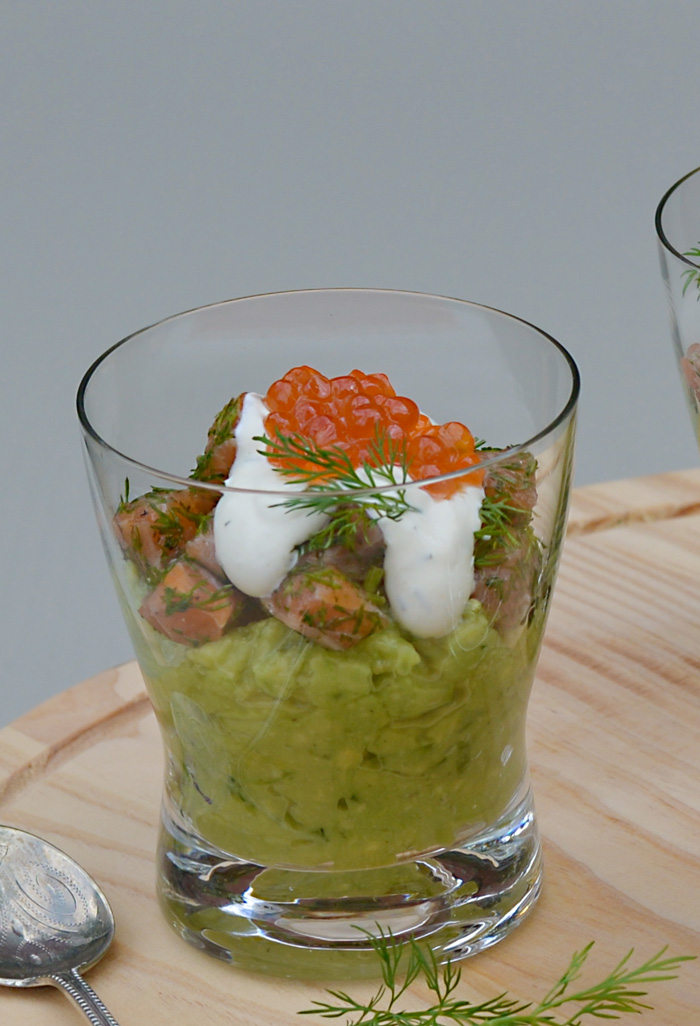
Salmon and avocado verrines / Verrines de salmão e pêra abacate.


The first time I made this recipe was when I had friends over and I served it as a starter. Apparently it was a success and everybody loved it a lot.
Since then, I make it from time to time, as a light meal, just because it's healthy, it's easy to make and the combination of flavours is great and I love all the ingredients in it.
ingredients (serves 6):
2 avocados, roughly mashed
2 tbsp lemon juice
3 spring onions, finely chopped
1 cucumber, peeled, seeds removed, finely chopped
2 tsp wasabi paste
500g very fresh salmon, finely chopped
2 tbsp chopped dill, plus extra sprigs to serve
150g creme fraîche or sour cream
salmon caviar, to serve
method:
Place avocado, lemon juice, spring onion, cucumber and 1 tsp wasabi paste in a bowl and stir gently to combine. Season with sea salt and freshly ground black pepper.
In a separate bowl, combine salmon and dill, then season.
Combine the creme fraiche with the remaining 1 tsp wasabi paste.
Divide avocado mixture among 6 x 200ml glasses, then top with the salmon mixture.
To serve, top the verrines with a spoonful of creme fraîche mixture, a small spoon of salmon caviar and extra dill sprigs.
__________________


A primeira vez que fiz esta receita, foi para servir como entrada num almoço entre amigos. Aparentemente foi um sucesso e toda a gente adorou!
Desde então, já a fiz outras vezes, como refeição ligeira, pois além de saudável, é deliciosa, fácil e rápida e adoro todos os ingredientes nela contidos.
ingredientes (para 6 pessoas):
2 pêras abacate, esmagadas grosseiramente
2 colheres sopa de sumo de limão
3 spring onions, picadas finamente
1 pepino, descascado, sementes raspadas e picado finamente
2 colheres chá de pasta de wasabi
500g salmão, o mais fresco possível, cortado em cubos bem pequeninos 
2 colheres opa de aneto picado + extra para servir
150g creme fraîche ou natas azedas
caviar de salmão, para decorar
preparação:
Numa taça, colocar o abacate, o sumo do limão, as spring onions, o pepino e 1 colher chá da pasta de wasabi. Misturar tudo muito delicadamente e temperar de sal e pimenta.
Numa taça à parte, combinar o salmão com o aneto picado e temperar de sal e pimenta.
Ainda numa outra taça, combinar o creme fraîche com o wasabi restante.
Dividir a mistura de abacate por 6 copos com capacidade para 200ml e por cima, colocar o salmão.
Colocar uma colher de creme fraîche em cada copo, seguido de uma pequena colher de caviar de salmão e decorar com aneto.

Recipe / Receita:

15 June 2015

Goat's cheese, strawberry and cucumber millefeuilles / Mil folhas de queijo de cabra, morangos e pepino.


I love to go through my book shelves and randomly, pick up a book that is there, without being touched for a long time and start reading it again, like if it was the first time.
It happens so often and it's like finding little treasures as each time I do that, I find more and more interesting combinations and recipes that I didn't pay attention on previous readings.
Its happening now, with this Rachel Khoo cook book, that I bought long ago and that until a while ago, I have never tried a recipe from it.
And by a while ago, I mean, until I tried this cannelés recipe, this pork ribs recipe and now, this amazing, totally stunning and delicious millefeuilles that I served as a starter and that is, not just beautiful and gorgeous for the eyes, but it is also fabulous and a real pleasant surprise for the palate.
ingredients (makes 6):
6 tbsp butter
2 tbsp runny honey
4 sheets of filo pastry (48cm x 22cm)
250g goat's cheese log, crumbled
20 basil leaves
1 large cucumber
2 tbsp white balsamic vinegar
200g ripe and firm Gariguette strawberries (or other if you can't find Gariguette), sliced
method:
Preheat the oven to 160ºC.
Melt the butter and 1 tbsp of the honey in a saucepan.
Place 1 sheet of filo pastry on the work surface with the long side facing you.
Brush pastry sheet with the butter and honey mixture.
Sprinkle with 100g of the cheese and top with 10 basil leaves (the pastry will be cut in 10 rectangles, so make sure you have one basil leaf in each rectangle, making 2 rows with five leaves each).
Place the second sheet of pastry on top and brush with the butter and honey.
Cut the pastry sheets in half lengthways and then into 10 rectangles.
Place the rectangles on a baking sheet and repeat with the remaining filo sheets, reserving the remaining 50g of cheese.
Bake for 10 minutes, or until the pastry is slightly golden.
Using a peeler to peel long cucumber ribbons (avoiding the soggy centre with the seeds).
Mix together the remaining honey with the balsamic vinegar and toss to coat the cucumber ribbons, strawberries and the remaining crumbled cheese.
Place a pastry rectangle on each plate and top with some of the salad.
Top with another layer of the pastry, more of the saldas and a final layer of the pastry.
Repeat to make another 5 portions.
You will be left with 2 extra rectangles, that you can eat as a snack.

__________________

Adoro quando pego em livros que já tenho há algum tempo e os começo a reler, como se da primeira vez se tratasse.
Acontece-me tantas vezes, livros que comprei e dos quais nunca tinha experimentado nenhuma receita e quando os releio, acabo sempre, invariavelmente, por descobrir verdadeiros tesouros, ou seja, receitas e combinações, ás quais não tinha prestado atenção da primeira vez que as vi e que agora, ao relê-las, ganham toda uma nova dimensão e interesse.
Assim foi com este livro da Rachel (entre tantos outros), que tenho desde o dia em que foi publicado e que li na altura, mas sem grande interesse por nenhuma receita em particular e foi posto na prateleira.
Voltou a sair das prateleiras há umas semanas atrás, na sequência das minhas aventuras no mundo dos cannelés e desde então, já experimentei a receita de cannelés que o fez sair da prateleira, esta de entrecosto e couscous de favas e esta que hoje vos apresento e que foi servida como entrada e que é absolutamente linda e sublime em termos de sabor. 


ingredientes (para 6):
6 colheres sopa de manteiga
2 colheres sopa de mel líquido
4 folhas de massa filo (com cerca de 48cm x 22cm cada)
250g queijo de cabra, desfeito em pedaços pequenos
20 folhas de manjericão
1 pepino grande
2 colheres sopa de vinagre balsâmico branco
200g morangos maduros mas firmes (de preferência da variedade Gariguette, ou outra se não encontrar esta variedade), fatiados
preparação:
Aquecer o forno a 160ºC.
Num tachinho, derreter a manteiga com 1 colher sopa do mel.
Por forma a ficar de frente para um dos lados mais longos da massa, colocar uma folha de massa filo sobre a bancada da cozinha. Pincelar uniformemente com a mistura de manteiga e mel, polvilhar com 100g do queijo e cobrir com 10 folhas de manjericão.
Atenção que a massa vai ser cortada em 10 rectângulos e convêm que cada rectângulo tenha uma folha de manjericão, por isso, espalhar as folhas em 2 linhas uniformes de 5 folhas de manjericão por linha.
Colocar a segunda folha de massa filo sobre o preparado anterior e voltar a pincelar com a mistura da manteiga e do mel.
Cortar esta composição de massa ao meio longitudinalmente e depois em 10 rectângulos.
Repetir o processo com as outras duas folhas de massa filo, reservando os 50g de queijo que sobram.
Colocar os rectângulos num tabuleiro e levar ao forno por 10 minutos, até estarem douradinhos.
Com um descascados de cenouras, cortar longas e finas fatias de pepino, descartando as do meio com as sementes.
Numa taça, misturar a restante colher de soap de mel, com o vinagre balsâmico.
Colocar as fatias de pepino no molho anterior, juntamente com os morangos fatiados e o restante queijo e envolver tudo muito bem.
No momento de servir, colocar um dos rectângulos de massa num prato de serviço. Cobrir com um pouco da salada de pepino, queijo e morangos, cobrir com uma segunda camada de massa, seguida de outra de salada, finalizando com um terceiro rectângulo de massa.
Repetir os passos anteriores para os restantes 5 pratos.
Sobrar-lhe-ão 2 rectângulos de massa, que podem ser comidos como snack e que são uma maravilha.

Recipe / Receita:

12 June 2015

Asparagus and prosciutto bundles with goat's cheese & hazelnut dip / Espargos enrolados em presunto, com dip de queijo de cabra e avelãs.


A fabulous suggestion for a starter or light lunch to be eaten at home, or to be put inside a sealable container to be transported in a picnic basket and enjoyed outdoors.
The combination of ingredients is one of my favourite ones, as it combines some of my beloved mediterranean flavours.
ingredients (makes 6):
18 asparagus spears, woody ends removed
olive oil, for drizzling
6 slices prosciutto
handful of rocket leaves
12 semi dried tomatoes
method:
Heat a griddle pan.
Drizzle the asparagus with a little olive oil and season with salt and freshly ground black pepper.
Cook for 3 to 4 minutes, rolling around the pan until just tender. Leave to cool.
Lay a slice of prosciutto on your chopping board. Put 3 asparagus spears on top, with the tips pocking out the end.
Top with a few rocket leaves and 2 semi dried tomatoes.
Roll up the prosciutto tightly to enclose the filling.
Repeat as above to make another 5 bundles.


for the dip:
100g cream cheese
100g soft goat's cheese, rindless
1 tbsp milk
6 to 8 hazelnuts, chopped
method:
Mash the cream cheese ands goat's cheese together in a bowl with a fork.
Season and add enough milk in order to have a smooth, dipping consistency.
Spoon the mixture into a jar or serving bowl and sprinkle over the hazelnuts.
__________________


Hoje deixo-vos com esta sugestão deliciosa que, tanto pode ser servida em casa, como entrada ou para um almoço ligeiro, como pode ser posta num recipiente de fecho hermético e transportada num cesto de piquenique e ser degustada à sombra, ou ao sol, sentados numa manta ou não, simplesmente desfrutando do bom tempo e temperaturas convidativas.
A combinação de ingredientes é, para mim, das mais apelativas, pois combina alguns dos sabores mediterrâneos que mais aprecio.
ingredientes (para 6 molhos):
18 espargos, arranjados e base do talo rija, descartada
azeite
6 fatias de presunto
um punhado de folhas de rúcula
12 tomates secos em azeite, escorridos
preparação:
Aquecer um grelhador.
Regar os espargos com um fio de azeite e temperar com sal e pimenta preta moída na altura.
Grelhar os espargos por 3 ou 4 minutos, ou até estarem macios mas al dente, rolando-os no grelhador. Deixar os espargos arrefecer.
Colocar uma fatia de presunto sobre uma tábua de cozinha. Colocar 3 espargos em cima do presunto, por forma a que as pontas dos espargos fiquem um bocadinho saídas.
Em cima dos espargos colocar folhas de rúcula a gosto e cobrir com 2 tomates secos.
Enrolar o presunto à volta desta combinação e repetir o processo até ter enrolado os 6 molhos de espargos.
Colocar num contentor de fecho hermético para levar para um piquenique, ou dividir por pratos e servir com o dip.


para o dip:
100g queijo creme (tipo Philadelphia)
100g queijo de cabra fresco, sem casca
1 colher sopa de leite
6 a 8 avelãs, picadas
preparação:
Numa taça e com a ajuda de um garfo, esmagar o queijo creme, juntamente com o queijo de cabra.
Temperar com sal e pimenta preta moída na altura e adicionar leite suficiente, por forma a obter uma mistura cremosa e com consistência de dip.
Colocar a mistura num frasco de fecho hermético, ou numa taça e polvilhar com as avelãs picadas.

Recipe / Receita: BBC Good Food magazine (May 2015).

31 October 2014

Baked mushrooms with goat's cheese, prosciutto and spinach / Cogumelos no forno com queijo de cabra, presunto e espinafres.


I love mushrooms and I am always keen to cook with them either mixed in stews and other dishes, or on their own, like these ones, just baked and topped with whatever you fancy.
This is a very easy and delicious light meal or starter and the work you have to put it together, is nothing compared with the amount of pleasure you'll have afterwards.
ingredients (serves 2 as a light meal, or 4 as a starter):
4 big portobello mushrooms, cleaned with kitchen paper
2 garlic cloves, finely minced
100g log goat's cheese, cut into 4 round slices
4 thin slices Parma ham
2 tbsp olive oil, plus 1 tbsp for the spinach
1 garlic clove, finely sliced
200g baby spinach leaves
method:
Preheat the oven to 200ºC.
Place the mushrooms, gills facing up, on a baking tray.
Scatter the minced garlic over the mushrooms, season with salt and pepper and put 1 round of the cheese on top of each.
Drizzle with 2 tbsp of olive oil, cover with foil and cook for 10 minutes.
Remove the foil and bake for a further 5 minutes.
Heat 1 tbsp of olive oil and the sliced garlic in a pan and as soon as the garlic starts to sizzle, add the spinach and wilt for 1 to 2 minutes.
When ready to serve, divide the spinach between 2 or 4 plates, top with the baked mushroom and decorate each mushroom with 1 slice of the Parma ham.
Sprinkle with freshly ground black pepper and serve straight away.
__________________


Eu confesso que sou apaixonada por cogumelos e sempre que tenho oportunidade, e são muitas, adoro cozinhar com cogumelos, quer misturados em guisados e afins, quer por si só, como estes, simplesmente assados no forno e acompanhados por outros ingredientes simples, mas deliciosos.
Eu servi esta receita como entrada, mas pode ser servida como uma refeição ligeira.
ingredientes (para 2 como refeição ligeira, ou para 4 como entrada):
4 cogumelos portobello grandes, bem limpos com papel de cozinha
2 dentes de alho, bem picadinhos
100g de queijo de cabra de cilindro, cortado em 4 rodelas
4 fatias finíssimas de presunto de Parma, ou outro
2 colheres sopa de azeite + 1 colher sopa de azeite para os espinafres
1 dente de alho, finamente fatiado
200g folhas de espinafre bebé
preparação:
Aquecer o forno a 200ºC.
Colocar os cogumelos num tabuleiro de ir ao forno, com a parte das "guelras" virada para cima.
Salpicar os cogumelos com o alho picado, temperar de sal e pimenta e colocar uma rodela de queijo em cima de cada um.
Regar com 2 colheres de sopa de azeite, cobrir com folha de alumínio e levar ao forno por 10 minutos.
Retirar a folha de alumínio e levar ao forno por mais 5 minutos.
Entretanto, aquecer 1 colher sopa de azeite e o alho fatiado num tacho.
Assim que o alho começar a ganhar um nadinha de cor, adicionar os espinafres e saltear por 1 minuto ou 2, ou até que as folhas de espinafre murchem.
No momento de servir, dividir os espinafres por 2 ou 4 pratos.
Colocar um cogumelo em cada prato e decorar cada cogumelo com 1 fatia de presunto.
Polvilhar com pimenta preta moída na altura e servir de imediato.


Recipe / Receita: Lia - Lemon & Vanilla.

25 August 2014

Prawn, avocado and coriander verrines / Verrines de pêra abacate, camarão e coentros.


These verrines were served last week as a starter for a friends lunch.
Served chilled, they were very much appreciated as the vibrant colour and combination of flavours are totally beautiful and delicious.
ingredients (serves 4 to 5):
200g king prawns, cooked, peeled and roughly chopped
4 king prawns, cooked and peeled, for decoration
2 ripe but firm avocados, preferably Hass
leaves from 10 coriander stalks, plus a few chopped leaves for decoration
2 tbsp olive oil
50ml ricotta cheese
lemon juice, to taste
salt and black pepper, to taste


method:
Put all the ingredients in a food processor, apart from the prawns and blend until smooth.
Place the mixture into a bowl and mix in the chopped prawns.
Adjust seasoning and add more lemon juice if needed.
Divide the mixture between 4 verrines or cocktail glasses and decorate with the whole prawn and chopped coriander.
Keep in the fridge and serve chilled.
__________________


Estas verrines foram servidas a semana passada como entrada num almoço entre amigos.
Uma entrada fresca e repleta de cor e sabor, sugestão que veio do fantástico blogue da Helena.
A receita está aqui, portanto é só experimentarem-na e confirmar o que escrevo!


Recipe / Receita: Sabores de Canela.

13 June 2014

Scallops and chorizo / Vieiras com chouriço.


Scallops are one of my favourite ingredients and the combination of them with chorizo is truly heavenly.
This suggestion, from a Nigel Slater programme, makes a fabulous starter for 6.
ingredients:
225g chorizo, sliced into 2cm rounds
4 spring onions, sliced
2 red chillies, thickly sliced
24 scallops, cleaned
2 tbsp runny honey
method:
Fry the chorizo on a hot frying pan until brown and the juices are running in the pan.
Add the spring onions and chillies and fry for 2 to 3 minutes.
Add the scallops and fry for a further 2 to 3 minutes on each side.
Drizzle over the honey and stir to coat.
Serve immediately.
__________________


Vieiras deve ser uma coisas que mais adoro e a sua combinação com chouriço é de bradar aos céus de tão boa que é.
Esta sugestão, que vi num programa do Nigel Slater, além de fácil de fazer, é uma entrada fabulosa para 6 pessoas e é altamente deliciosa.
ingredientes:

225g de chouriço, cortado em rodelas de cerca de 2cm
4 spring onions, cortadas em rodelas
2 malaguetas vermelhas, cortadas em fatias grossas
24 vieiras, arranjadas e limpas
2 colheres sopa de mel líquido
preparação:
Fritar o chouriço numa frigideira bem aquecida, até este estar douradinho e tiver começado a libertar a própria gordura.
Adicionar as spring onions e as malaguetas e fritar por 2 ou 3 minutos.
Adicionar as vieiras e fritar por mais 2 ou 3 minutos de cada lado.
Regar com o mel, misturar muito bem e servir de imediato.

8 January 2014

Duck terrine / Terrina de pato.


This amazing terrine was served with a very delicious chutney as a starter for Christmas Eve and it was a huge success as it is easy to make and all the flavours are absolutely stunning.
ingredients (serves 8 to 10 as a starter):
3 large bay leaves
around 8 long, thin rashers of streaky bacon, rind removed
2 large garlic cloves, chopped
450g minced pork
1 1/2 tsp salt
ground black pepper
grated zest and juice of 1 large orange
2 tbsp white wine or dry vermouth
150g fresh white breadcrumbs
100g unsalted pistachio nuts, shelled
2 large duck breasts
method:
Preheat the oven to 200ºC and grease a loaf tin measuring around 23 x 11.5cm.
Lay the bay leaves down the centre of the tin.
Stretch out each bacon slice thinly and arrange them - overlapping - across the length of the loaf tin on top of the bay leaves. Any surplus bacon can be left hanging over the edge of the tin as this can be folded in over the meat mixture when the tin is full. Cut a bacon slice into three to line each short end of the tin.
Process the garlic and pork for 20 seconds. Add the salt, a generous amount of pepper, the orange zest and juice, the wine and the breadcrumbs and whizz again, just enough to combine everything together.
Press half the mixture into the lined tin, level with the back of a spoon then sprinkle in half the pistachio nuts.
Skin the duck breasts - reserving the skin - and cut the meat into strips down the length of the breasts and arrange these lengthways in the tin.
Season with salt and pepper and sprinkle with the remaining nuts.
Press the remaining meat mixture on top, level, and fold the bacon strips in over the meat.
Cover the meat with the duck skins to keep the terrine moist.
Cover the tin with foil and put it inside a roasting tin filled with sufficient boiling water to come half way up the side of the loaf tin.
Bake for 1 1/4 hours or until cooked through. Remove the foil and discard the duck skin.
Remove the loaf tin from the water bath and leave to cool for about 2 hours.
When the terrine is cold, cover the surface with a sheet of clingfilm and put a matching size loaf tin on top. Put weights inside the second loaf tin. Put the whole thing in  a dish to catch any juices and refrigerate for 24 to 48 hours to become firm.
Turn the terrine out of the tin onto a serving plate and serve at room temperature.
__________________


Esta fabulosa terrina foi servida como entrada na noite de Consoada, acompanhada por um fantástico chutney caseiro e posso assegurar-vos que, além de linda, é fácil de fazer e foi alvo de múltiplos cumprimentos.
ingredients (como entrada, serve 8 a 10 pessoas):
3 folhas de louro grandes
cerca de 8 fatias de bacon, sem courato
2 dentes de alho grandes, picados
450g carne de porco picada
1 1/2 colheres chá de sal
pimenta preta moída
raspa e sumo de 1 laranja
2 colheres sopa de vinho branco ou de vermute seco
150g pão branco fresco, ralado
100g pistachios descascados e sem sal
2 peitos de pato grandes
preparação:
Aquecer o forno a 200ºC e untar uma forma de bolo inglês, com cerca de 23 x 11,5cm.
Colocar as folhas de louro no fundo da forma.
Esticar as fatias de bacon de forma a ficarem fininhas e sobrepondo-as ligeiramente, forrar a forma a todo o comprimento, cortando algumas fatias em 3, para forrar os lados pequenos da mesma.
Deixar o bacon excedente cair para fora da forma, para depois poder ser dobrado sobre o preparado da terrina.
Colocar o alho e a carne de porco no copo do robot de cozinha e processar por 20 segundos.
Adicionar o sal, uma boa dose de pimenta preta moída, a raspa e sumo da laranja, o vinho e o pão ralado e processar de novo, só para combinar tudo muito bem.
Colocar metade desta mistura na forma, em cima das folhas de louro e nivelar com as costas de uma colher.
Espalhar metade dos pistachios por cima do preparado anterior.
Retirar a pele ao pato, reservando-a e cortar os peitos de pato ás fatias, no sentido do comprimento.
Espalhar as fatias de pato sobre os pistachios, pelo comprimento da forma.
Temperar com sal e pimenta e cobrir com o resto dos pistachios.
Finalizar distribuindo o resto da mistura da carne por cima, alisando bem e dobrar o bacon excedente sobre a carne.
Cobrir com as peles de pato reservadas, a fim de evitar que a terrina fique muito seca e tapar a forma com folha de alumínio.
Colocar a forma num tabuleiro de lados altos e encher com água a ferver até meio da altura da forma da terrina.
Cozer por cerca de 1 1/4 horas, ou até a carne estar bem cozida.
Retirar o papel de alumínio, descartar as peles do pato e retirar a forma do banho maria.
Deixar arrefecer a terrina por cerca de 2 horas. Cobrir com película aderente e colocar uma forma de igual tamanho em cima da terrina, com algum peso lá dentro, a fim de comprimir a carne.
Colocar tudo dentro de um prato (para apanhar algum líquido que escorra) e refrigerar por 24 a 48 horas para a terrina ficar firme.
Desenformar a terrina sobre um prato de serviço e servir à temperatura ambiente.

Recipe / Receita: