


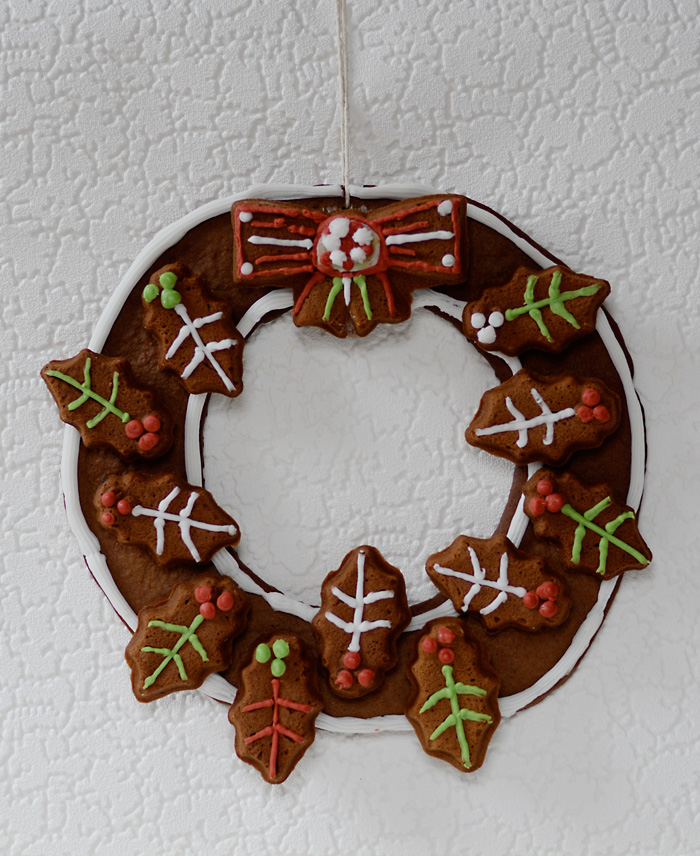
The December issue of Delicious Magazine arrived full of gorgeous and scrumptious suggestions for Christmas and my first Christmas bake this year, is this gingerbread wreath.
The gingerbread dough itself, is from Mima Sinclair fantastic book "Gingerbread Wonderland" and it's the best gingerbread I ever tried. It is so easy to work with that it will be the dough I'm going to use for the annual gingerbread house (if I have the time to make it of course...).
The gingerbread dough itself, is from Mima Sinclair fantastic book "Gingerbread Wonderland" and it's the best gingerbread I ever tried. It is so easy to work with that it will be the dough I'm going to use for the annual gingerbread house (if I have the time to make it of course...).
For the decorations, I used shop bought icing but feel free to make your own.
ingredients for the gingerbread dough:
60g light molasses, golden syrup or honey
80g black treacle (for a darker dough like mine)
Note: If you don't want to use the black treacle, use 140g of the golden syrup, molasses or honey.
200g soft light brown sugar
200g unsalted butter
finely grated zest of 1 lemon
4 tsp ground ginger
2 tsp ground cinnamon
1/2 tsp freshly grated nutmeg
1/4 tsp ground cloves
1/2 tsp bicarbonate of soda
500g plain flour
1 tsp salt
1 medium egg, lightly beaten
for the decoration:
white, red and green icing or royal icing (or any other colours you fancy)
caramel glue, optional
method:
In a large saucepan, heat the golden syrup, black treacle, sugar, butter, lemon zest and spices, stirring over a low to medium heat, until the sugar has dissolved.
Increase the heat and bring the mixture to a boiling point, then take off the heat and beat in the bicarbonate of soda.
Leave to cool for 15 minutes and then pour the mixture into a large mixing bowl.
Sift the flour and salt, then fold into the spiced sugar mixture in batches, using a wooden spoon or a stand mixer.
Add the egg and beat until just combined.
The dough will be very sticky but don't be tempted to add more flour.
Scrape out the dough onto a clean surface and knead together until just smooth.
Wrap in clingfilm and chill in the fridge for 1 hour.
Preheat the oven to 160ºC.
Line 3 large baking trays with baking paper.
Cut a large piece of baking paper and roll out the gingerbread dough on top of it until 5mm thick.
Put a 25cm plate on the dough and cut round it. Using a smaller plate, cut out the centre to give a 4cm wide ring of dough.
Using different size cutters and shapes, cut out shapes from the remaining dough.
Freeze the gingerbread shapes for 5 minutes until hard.
Bake the shaped biscuits in batches, for 10 to 15 minutes or until golden brown at the edges.
Bake the ring for 15 to 20 minutes or until golden brown at the edges.
Leave to cool inside the trays for 5 minutes and then transfer onto wire racks to cool completely.
Once cooled, decorate with the icings and colours of your choice. Arrange the shapes to taste on the ring.
Using the white icing or caramel (made with 200g sugar and 60ml of cold water), glue the back of the biscuits to the ring and leave to set firm.
__________________
A revista Delicious deste mês vem recheada de lindas e deliciosas sugestões para o Natal e uma delas, é uma coroa de gengibre decorada com estrelas, mas que eu decidi decorar com folhas de azevinho.
Embora a receita venha na revista, a mesma é retirada do livro "Gingerbread Wonderland" da autora Mima Sinclair.
Embora a receita venha na revista, a mesma é retirada do livro "Gingerbread Wonderland" da autora Mima Sinclair.
A massa de gengibre, é, sem dúvida, a melhor que já fiz e é tão fácil de trabalhar que, se ainda tiver tempo claro, será com esta base de massa que farei a casinha de gengibre.
Quanto ao sabor, é também o mais delicioso biscoito de gengibre que já provei.
Quanto ás decorações, eu usei icing de compra e em bisnaga, mas se quiserem, podem fazer o vosso em casa e colori-lo a gosto e de acordo com os formatos de biscoito escolhidos.
Assim sendo, aqui fica a coroa de Natal de gengibre, a primeira sugestão de Natal a sair da minha cozinha!
ingredientes para a massa de gengibre:
60g melaço light, golden syrup ou mel (eu usei golden syrup) ou 140g de uma destas opções, caso não queiram usar o black treacle que está mencionado a seguir.
80g black treacle (no caso de quererem um biscoito escuro como o meu)
200g açúcar amarelo
200g manteiga sem sal
raspa de 1 limão
4 colheres chá de gengibre em pó
2 colheres chá de canela em pó
1/2 colher chá de noz moscada ralada na altura
1/4 colher chá de cravinho em pó
1/2 colher chá de bicarbonato de sódio
500g farinha de trigo branca
1 colher chá de sal fino
1 ovo médio, ligeiramente batido
para decorar:
icing vermelho, verde e branco ou as cores escolhidas de acordo com o formato dos biscoitos,
caramelo, para colar, opcional
preparação:
Num tacho sobre lume baixo a médio, colocar todos os primeiros ingredientes e todas as especiarias (9 primeiros ingredientes).
Aquecer, mexendo sempre, até o açúcar estar dissolvido.
Aumentar o lume e deixar que a mistura atinja o ponto de ebulição. Retirar o tacho do lume e adicionar o bicarbonato de sódio, mexendo bem.
Deixar a mistura arrefecer por 15 minutos e depois transferi-la para uma taça.
Peneirar a farinha com o sal e adicioná-la, em 2 ou 3 vezes, à mistura anterior, mexendo bem com uma colher de pau ou, se preferir, com a batedeira eléctrica.
Adicionar o ovo batido e bater só até este estar incorporado (atenção para não bater em demasia).
A massa ficará molenga e pegajosa mas não adicione mais farinha.
Colocar a massa sobre a bancada da cozinha e amassar, só até esta estar macia.
Embrulhar a massa em película aderente e refrigerar por 1 hora.
Aquecer o forno a 160ºC.
Forrar 3 tabuleiros com papel vegetal.
Sobre uma folha grande de papel vegetal, estender a massa com o rolo, até obter uma espessura de cerca de 5mm.
Colocar um prato com cerca de 25cm de diâmetro sobre a massa e cortar a massa à volta do prato.
Colocar um prato menor ou uma tigela em cima do círculo anterior (no centro) e cortar à volta, a fim de obter um anel com cerca de 4 cm (usar o centro cortado para os biscoitos).
Colocar o anel num dos tabuleiros preparados e congelar por 5 minutos.
Com cortadores de biscoitos das formas e tamanhos desejados, cortar formas com o restante massa e colocá-las nos tabuleiros. Congelar por 5 minutos.
Levar o tabuleiro com o anel ao forno e cozer por a 20 minutos, ou até os bordos estarem douradinhos.
Cozer os restantes biscoitos no forno, por cerca de 10 a 15 minutos, ou até estarem douradinhos nos bordos.
Deixar tudo arrefecer nos tabuleiros por cerca de 5 minutos, antes de transferir para grelhas, para arrefecimento completo.
Depois de frios, decorar os biscoitos a gosto e com as cores de icing escolhidas.
Arranjar os biscoitos em cima do anel, até obterem o efeito desejado.
Usar o icing branco para colar as costas dos biscoitos ao anel ou, caso prefiram, usem caramelo (façam um caramelo com 200g açúcar refinado branco e 60ml de água fria) como cola.
Depois de colados todos os biscoitos, deixar a coroa repousar até o icing ou o caramelo estarem completamente secos e firmes.

Recipe / Receita: Delicious magazine - December 2015.


