Showing posts with label Kale / Couve.. Show all posts

12 May 2017

Smoky Paprika Chicken with Crispy Chickpeas, Roasted Lemon and Kale / Frango com Paprika Fumada, Grão de Bico Crocante, Limão assado e Kale.


By the amount of chicken recipes that I publish, you might well already guessed that we love chicken here at home. Well, it's true!
This recipe, from Melissa Clark "Dinner: Changing the Game" cook book is a stunner!
The chicken is moist inside, with a perfectly crisp skin outside. The combination of the lemon, kale and crispy chickpeas is totally genius and the whole dish is absolutely delicious and full of textures and contrasts.
As you Know, this month we are cooking from Melissa's book for the Rainydaybites Cook Book Club and of course, this recipe had to be shared because you'll be in love with it if you get to try it and, it's also super easy to put together.

5 March 2017

Kale and Quinoa with Savoury Granola / Kale e Quinoa com Granola Salgada.


Breakfast food that you know, for me is a perfect lunch!
As I promised here, today I'm sharing this super delicious savoury granola.
Actually, I made this recipe a while ago and if you're following my instagram, you can see it here, as I shared it the day I made it. Although I'm only sharing it today, this was the very first recipe that I made from Nina Olsson gorgeous "Bowls of Goodness" cook book. A book that I truly adore and from which I talked about in this same post.
This savoury granola is perfect, not just for this recipe but also to sprinkle over salads, soups, or whatever you fancy.

5 October 2016

Baked risotto with beef meatballs and curly kale / Risotto no forno, com almôndegas e couve kale.


This fabulous risotto was inspired by this Emilie Raffa recipe.
I've already made the original recipe once, with the chicken sausage, and I posted the photo  here on my instagram account.
The thing is, if I made it again, it's not difficult for you to guess how fantastic and delicious it is, right?
This baked risotto is so tasteful and simple to make, that I think that I'll never be making risotto in the traditional (stirring) way again...
As I wrote above, the first time, I made it with the sausages like it is described by Emilie. This time, I had some meatballs in the fridge and I didn't want to make them with pasta so, looking at a bag of leftover curly kale that needed to be used, I straightaway thought of making Emilie's baked risotto again but, using those two ingredients.
My opinion? Honestly?
The result couldn't be more delightful and the combination, absolutely delicious!!


2 June 2016

Wet rice with chorizo, kale and spinach / Arroz Robusto.


When something is truly delicious, you don't mind having it often right?
Well, that's exactly what happened with this dish.
When I got the gorgeous Mónica Pinto "Pratos e Travessas" cookbook last week, after marking down - almost all the recipes - this one, was the one that I decided that would be the first one to be tested.
The day I got the book, I was in doubt about what to make for dinner and as soon I saw this recipe and read the ingredients, I made it that same day.
The result couldn't be more spectacular but, as it was very late, I didn't take photos. This week, as everybody at home was asking me to make it again (that's how delicious it is), I took my time to take the pictures so I could share the recipe with you all.
I have to say that, in my opinion, is the most beautiful and complete Portuguese Food blog and there's no portuguese food blog that can be compared to hers.
Everything, starting with the recipes, photos, landscape images and the way Mónica writes, is absolutely fascinating.
I still remember the first time I came across Pratos e Travessas. I was so astonished, that it took me some time to realise that it was a portuguese blog and since then, I read the blog and every post, every time Mónica updates it. The recipes, usually, are fabulous and Mónica writes both in portuguese and english and for the photos, I confess, I spend hours, admiring them!!
Saying that, here it is, the first recipe from the absolutely AMAZING, Mónica's debut cookbook, "Pratos e Travessas"!
"Arroz Robusto" is the name of the recipe, which is, nothing but a very delicious, comforting and well balanced wet rice dish with all the trimmings that will be named below.


ingredients (serves 4):
3 tbsp olive oil
1 medium onion, finely chopped
2 garlic loves, finely chopped
1 bay leaf
125g chorizo, cut into 1cm rounds
1 medium carrot, thinly sliced
1 big and very ripe tomato, skinless and seedless, chopped
50g baby spinach leaves
100g curly kale, finely shredded
1 x 400g can red kidney beans, drained and rinsed
3 cups chicken or vegetable stock
1/2 cup long grain rice
sea salt flakes and freshly ground black pepper, to taste
method:
Heat the olive oil in a heavy based saucepan.
Add the onion, bay leaf and garlic and cook over a medium heat until the onion is softened and lightly golden brown.
Add the carrot and chorizo and cook for 3 to 4 minutes, stirring occasionally.
Stir in the tomato and cook for 1 minute.
Add the spinach, kale, beans and stock. Stir and bring to the boil.
Add the rice and when it comes back to the boil, reduce the heat to low, cover the pan and simmer until the rice is al dente (about 10 to 12 minutes), stirring from time to time, to release the starch form the rice. When cooked, but al dente, the rice should be very wet. If needed, add more boiling stock or water.
Season with sea salt flakes and freshly ground pepper to taste.
Turn off the heat and allow the rice to rest, covered, for 5 minutes.
Serve immediately.

__________________

Começo por vos dizer que, há anos atrás, quando me deparei pela primeira vez com o blogue Pratos e Travessas, da Mónica Pinto, nem queria acreditar que era um blogue Português.
Não desmerecendo ninguém, claro, acho que o Pratos e Travessas está muito para além,  de todos, e qualquer um, dos blogues de culinária portugueses.
O Pratos e Travessas é, na minha humilde opinião, claro, um blogue completo e que abrange todos os "parâmetros" requeridos para um blogue de culinária de sucesso e não é à toa que é um blogue reconhecido internacionalmente.
Quando me deparei com o Pratos e Travessas pela primeira vez, o que me fascinou à partida, foram as fotos espectaculares e o rustico e "dark mood" das fotos da Mónica que, confesso, amo de paixão (mais que o "light mood").
As receitas, nada deixam a desejar e tenho muitas delas em fila de espera para serem testadas, senão, experimentem a receita da Francesinha da Mónica e digam-me se não é das melhores que já comeram (eu já a fiz cá em casa).
O blogue, por si, "clean" e com estilo e escrito em duas línguas, foi o culminar do meu deslumbre e, desde o dia que conheci o blogue da Mónica que, embora nem sempre (ou quase nunca) comente, acompanho todos os seus "updates" pois é, repito, o blogue de culinária português mais lindo de sempre!
Quando a Mónica anunciou que estava a escrever um livro, fiquei deveras entusiasmada, pois se há livro de blogger portuguesa que eu haveria de encomendar sem hesitar, seria um livro da Mónica Pinto e, assim foi!
Assim que o livro foi publicado, lá arranjei meios de o encomendar, pois distância nunca será impeditivo, desde que se queira muito!
Esta foi a primeira receita a ser testada e, confesso, é a segunda vez que faço este prato cá em casa!
Quando algo é absolutamente delicioso e simples de fazer e a família pede "bis", não é difícil repetir certo?
Pois bem, foi o que aconteceu com esta receita! Recebi o livro - LINDO - da Mónica Pinto, o "Pratos e Travessas", a semana passada. Nesse dia, ainda nem tinha decidido, nem sabia bem o que iria ser o jantar e ao folhear o livro da Mónica, deparei-me com esta receita.
Li os ingredientes, comuns cá em casa, e nem me preocupei mais, pois o jantar estava decidido: Seria o "Arroz robusto" da Mónica.
Foi o jantar desse mesmo dia mas, como já era de noite quando o finalizei e nem fotos tirei, decidi, a pedido dos comensais cá e casa, repeti-lo, pois é tão maravilhoso, simples e com sabores tão tipicamente portugueses que, para nós que estamos fora do País, soube a "céu", como podem imaginar e repetir, não foi de todo um sacrifício, antes pelo contrário!!
Fica então a sugestão para quem quiser experimentar!


ingredientes (para 4 pessoas):
3 colheres sopa de azeite
1 cebola média, picada
2 dentes de alho, picados
1 folha de louro
1 cenoura média, descascada e cortada em rodelas
8 rodelas de chouriço
1 tomate grande, maduro, sem pele nem sementes, cortado em pedaços
50g folhas de espinafres
3 folhas de couve portuguesa (eu usei kale), cortada em pedaços
150g feijão encarnado, cozido (eu usei uma lata pequena, feijão escorrido e passado por água limpa)
sal e pimenta preta moída na altura, a gosto
5 chávenas de café de arroz agulha (eu usei só 1/2 chávena "cup")
o triplo do volume do arroz em caldo de galinha de boa qualidade (eu usei 3 "cups" de caldo de legumes).


preparação:
Aquecer o azeite num tacho.
Adicionar a cebola, o louro e o alho e refogar sobre lume médio, até a cebola estar douradinha.
Adicionar todos os restantes ingredientes, excepto o arroz e deixar ferver por 10 minutos, com o tacho "meio" tapado.
Adicionar o arroz, temperar de sal e pimenta e mexer com um garfo.
Assim que levantar fervura, mexa de novo, baixe o lume para o mínimo e cozinhe, com tampa, por cerca de 12 minutos, mexendo 1 ou 2 vezes durante este período, a fim de libertar a goma do arroz.
Atenção que o arroz deve ficar bem malandro e, caso seja necessário, adicione mais caldo a ferver e rectifique os temperos.
Sirva de imediato.

Recipe / Receita:

8 May 2016

Sausage, kale and potato bake / Gratinado de salsicha fresca, couve kale e batata.


Perfect Plates in 5 ingredients is the title of John Whaite new book and, as you can guess by the title, is a fabulous book, full of recipes using only 5 ingredients.
As all the recipes look delightful and easy to make, specially when in a hurry, I have lots of recipes marked down to try but for now, my first choice was this delicious bake from the "morning" section.
As I wrote somewhere before, I love breakfast food for lunch or dinner and always, each time I'm flicking through a new book, the "breakfast" or "morning" chapters, are always my favourite ones.
ingredients (serves 4 to 6):
500g sausages, meat squeezed and casing discarded
150g kale, finely chopped and thicker stalks discarded
400g floury potatoes, peeled and coarsely grated
250g strong Cheddar cheese or Emmental, grated
9 large eggs
sea salt flakes and freshly cracked black pepper
olive oil, for frying


method:
Preheat the oven to 200ºC.
Heat 1 tsp olive oil in a frying pan over a medium high heat.
Add the sausage meat and chopped kale and fry until the meat is cooked and slightly browned.
Transfer to a mixing bowl.
Place the grated potatoes onto a clean, dry tea towel and sprinkle with 1 tsp of sea salt. Tightly squeeze the potatoes to remove every last drop of moisture.
Add the potatoes to the frying pan with another teaspoon of oil and stir fry until soft.
Add the cooked potatoes to the bowl with the kale and meat.
Add the cheese and season with 1 tsp of grated black pepper and a little more salt. Toss everything together.
Beat the eggs in another bowl, then add them to the potato mixture and stir everything together.
Tip into a pie dish and bake for 40 to 50 minutes or until golden brown and set.
Remove from the oven and allow to cool for 10 minutes before serving.

__________________

Perfect Plates in 5 ingredients é o título do novo livro do John Whaite.
Como podem deduzir pelo título, é um livro recheado de receitas lindas, apetitosas e, todas elas, usando apenas 5 ingredientes.
Embora o livro tenha um capítulo dedicado ao "slow cooking", quase todas as receitas neste livro são magníficas, fáceis e rápidas de fazer, especialmente para aqueles dias em que o tempo é curto.
Como já escrevi algures, não sou de grandes pequenos almoços, mas adoro comida de pequeno almoço ao almoço ou ao jantar e como tal, os capítulos dos livros que sempre me cativam mais e de imediato, são os capítulos de "pequeno almoço".
Esta receita, a primeira testada, de entre muitas marcadas, saiu precisamente do capítulo da comida das "manhãs" e foi muito apreciada aqui em casa, mas ao jantar.


ingredientes (para 4 a 6 pessoas):
500g salsichas frescas de boa qualidade, carne espremida e pele (exterior) descartada(o)
150g couve kale, picada finamente e talos mais grossos descartados
400g batatas, descascadas e raladas grosseiramente
250g queijo Cheddar maduro ou queijo Emmental, ralado
9 ovos grandes (L)
flocos de sal e pimenta preta moída na altura
azeite, para fritar


preparação:
Aquecer o forno a 200ºC.
Numa frigideira sobre lume médio a alto, aquecer uma colher de chá de azeite.
Adicionar a carne das salsichas e a couve e fritar, mexendo, até a carne estar macia e corada.
Transferir a mistura para uma taça.
Entretanto, colocar as batatas raladas num pano de cozinha limpo, adicionar uma colher de chá de sal e espremer bem o pano, a fim de eliminar todo o líquido proveniente das batatas.
Aquecer mais 1 colher de chá de azeite na frigideira, adicionar as batatas raladas e bem espremidas e fritar, mexendo, até estas estarem macias.
Transferir as batatas para a taça onde colocou a couve e as salsichas.
Adicionar o queijo ralado, pimenta e sal a gosto e misturar tudo muito bem.
Bater os ovos numa taça à parte e de seguida, adicioná-los à mistura anterior, envolvendo tudo muito bem.
Colocar a mistura num tabuleiro ou recipiente refractário e levar ao forno por 40 a 50 minutos, ou até estar douradinho e firme ao toque.
Retirar do forno e, antes de servir, deixar arrefecer por 10 minutos.

Recipe / Receita:

23 November 2015

Minestrone verde.


This minestrone is a very delicious and comforting wintery italian soup. It is a meal in itself and perfect for these cold days.
The recipe is from Theo Randall, a fabulous Chef that I truly adore.
ingredients (serves 4):
2 tbsp extra virgin olive oil
3 celery sticks, finely chopped
1 red onion, chopped
2 carrots, chopped
1 garlic clove, finely sliced
2 x 400g cans chopped tomatoes
1kg swiss chard (I used curly kale)
1 x 400g can or jar of borlotti beans, drained and rinsed
5 basil leaves
sea salt and freshly ground black pepper
fruity olive oil, to serve
method:
Heat the oil in a large saucepan.
Add the celery, onion, carrots and garlic and cook on a low heat for 20 minutes until soft, stirring from time to time.
Add in the tomatoes and stir, then cook for a further 20 minutes, stirring occasionally.
Meanwhile, remove the chard or kale leaves from the stalks. Leave the leaves whole and finely chop the stalks.
Blanch the leaves in a large pan of boiling salted water for about 3 minutes, or until tender.
Using tongs, remove the leaves from the water, drain them on a colander, chop them and set aside.
Add the chopped stalks to the water and cook for 3 minutes or until tender. Remove from the water, drain and set aside.
Reserve the blanching water.
Add the beans to the tomato mixture and cook for 10 minutes.
Add 400ml of the blanching reserved water to the mixture, bring to the boil and then simmer for 5 minutes.
Add the blanched leaves and stalks along with the basil leaves.
Season with salt and freshly ground black pepper and serve the soup topped with a good dash of fruity olive oil.


Note: I served my soup topped with a scatter of grated parmesan cheese.
__________________

Hoje deixo-vos com mais uma sopinha, o famoso minestrone italiano, do qual existem várias versões, sendo esta versão do Chef Theo Randall, uma versão bem deliciosa e perfeita para estes dias frios.
Uma sopa que pode ser (e foi), uma refeição por si só, pois é uma sopa robusta, com carácter e super reconfortante.


ingredientes (para 4 pessoas):
2 colheres sopa de azeite extra virgem
3 talos de aipo, cortados em rodelas fininhas
1 cebola roxa, picada
2 cenouras, cortadas em pequenos cubos
1 dente de alho, finamente fatiado
2 latas de 400g (cada) de tomate picado
1kg acelgas (eu usei couve frisada)
1 lata ou frasco de 400g de feijão borlotti, escorrido e passado por água
5 folhas de manjericão
sal e pimenta preta moída na altura
azeite frutado, para servir
preparação:
Aquecer o azeite numa panela grande.
Adicionar o aipo, a cebola, as cenouras e o alho e cozinhar sobre lume brando, por cerca de 20 minutos, ou até os legumes estarem macios, mexendo de vez em quando.
Adicionar o tomate, mexer e cozinhar por mais 20 minutos, mexendo regularmente.
Entretanto, separar as folhas das adelgas ou da couve dos talos, mantendo as folhas inteiras e picando os talos muito bem.
Numa panela de água a ferver com sal, escaldar as folhas por cerca de 3 minutos, ou até estarem macias.
Retirar as folhas da panela com a ajuda de pinças ou uma escumadeira e escorrê-las num coador.
Picar as folhas e reservá-las.
Na mesma água, escaldar os talos picados até estarem macios e escorrê-los e reservá-los, reservando também a água onde se escaldaram os verdes.
Adicionar o feijão à mistura do tomate e cozinhar por 10 minutos.
Adicionar 400ml da água de escaldar os verdes à mistura anterior. Deixar levantar fervura, baixar o lume e cozinhar por 5 minutos.
Adicionar as folhas e os talos escaldados à mistura anterior, assim como as folhas de manjericão.
Temperar a sopa a gosto, com sal e pimenta preta moída na altura.
Servir a sopa regada com um bom fio de azeite frutado.

Nota: Eu servi a sopa polvilhada com um bocadinho queijo parmesão ralado, pois acho que combina na perfeição com este tipo de sopas.

Recipe / Receita:

6 April 2015

Caldo Verde.


Caldo verde is a very traditional portuguese cabbage soup.
In our traditional recipe, the base of the soup is a potato purée and the cabbage is cut into a very, very fine chiffonade. One slice of cooked chorizo will be added at the end and will be found at the bottom of the mug or bowl.
I love when I find portuguese inspired recipes in cook books that are not portuguese and this version of the portuguese caldo verde, comes in this fabulous book.
I have to tell you that, although I love the traditional portuguese caldo verde, this version is more to my liking as it is made and presented in a very rustic, hearty and chunky way.
ingredients (serves 2):
1/2 tbsp unsalted butter
1/2 onion, finely chopped
1 garlic clove, finely chopped
1/2 tbsp olive oil
1 leek, halved lengthways and thinly sliced
1 potato, cut into 1cm cubes
1/2 tsp paprika
600ml vegetable stock, hot
1/2 tbsp tomato purée
50g cooking chorizo, cut into 1cm cubes
50g kale, hard stems removed and leaves shredded
extra virgin olive oil, to drizzle
sea salt flakes


method:
Heat the butter in a saucepan. Add the onion and cook gently for a few minutes. Add the garlic and cook for a further 2 minutes.
Add the olive oil and leek and cook for 5 minutes, or until the leek is soft.
Add the potato, salt and paprika and cook, stirring well, for a couple of minutes.
Add the stock and tomato purée and bring to the boil. Reduce the heat and cook until the potatoes are almost tender.
Add the kale and cook for about 5 minutes, or until tender. Season with salt.
Heat a skillet or frying pan over medium heat. Add the chorizo and fry until slightly crispy. Set aside.
Ladle the soup into bowls and top with the fried chorizo and a drizzle of extra virgin olive oil.
__________________

O nosso português caldo verde dispensa apresentações entre nós certo?
Adoro quando encontro receitas portuguesas ou inspiradas em receitas portuguesas, em livros estrangeiros e foi o caso deste caldo verde que encontrei neste livro magnífico.
Tenho a dizer que, embora seja grande apreciadora do nosso caldo verde, cortado fininho e com a base de puré de batata, esta versão foi uma muito, muito agradável surpresa, pois eleva o nosso caldo verde a uma dimensão um bocadinho superior e dá-lhe mais sabor e textura.


ingredientes (para 2 pessoas):
1/2 colher sopa de manteiga sem sal
1/2 cebola, finamente picada
1 dente de alho, finamente picado
1/2 colher sopa de azeite
1 alho francês, cortado ao meio no sentido do comprimento e finamente fatiado
1 batata, cortada em cubos de 1cm
1/2 colher chá de paprika
600ml caldo de legumes, quente
1/2 colher sopa de concentrado de tomate
50g chouriço, cortado em cubos de 1cm
50g couve portuguesa, talos grandes removidos e folhas esfarripadas
azeite extra virgem, para regar
flor ou flocos de sal
preparação:
Derreter a manteiga numa panela. Adicionar a cebola e cozinhar por uns minutos. Adicionar o alho e cozer por mais 2 minutos.
Adicionar o azeite e o alho francês e cozinhar por 5 minutos, ou até este estar macio.
Adicionar as batatas, o sal e a paprika, mexer bem e cozinhar por uns minutos.
Adicionar o caldo de legumes e o concentrado de tomate e mexer. Quando levantar fervura, baixar o lume, e cozinhar até que as batatas estejam quase cozidas.
Adicionar a couve e cozer por cerca de 5 minutos, ou até esta estar macia. Temperar de sal.
Entretanto, numa frigideira bem quente, mas sem adicionar nenhum tipo de gordura, fritar os cubos de chouriço até estarem douradinhos.
Servir a sopa em tigelas, com o chouriço por cima e regar com um fio de azeite.

Recipe / Receita:

1 September 2014

Polenta, vegetables and feta savoury bundt cake / Bundt cake salgado de polenta, recheado om legumes e feta.


As I wrote here, I loved Susana's savoury bundt cake so much, that the day after she published it, I had to give it a go.
I followed Susana's directions for the cake, but I adapted the filling in order to finish some bits and bobs that were wondering in the fridge and also because I wanted to use the fantastic feta cheese that I bought at the Edinburgh foodies festival.
ingredients for the cake (8 to 10 slices):
2 eggs
260ml milk
150ml sunflower oil
160g polenta
120g plain flour
1 tsp baking powder
1 tsp fine sea salt


ingredients for the filling:
2 tbsp olive oil
3 garlic cloves, peeled and thinly sliced
150g curly kale, very thinly sliced
150g roasted red peppers, from a jar is fine
60g sundried tomatoes, drained and chopped
3 tbsp salsa verde (I used this one)
120g feta cheese, cubed


method:
Preheat the oven to 180ºC. Grease a bundt cake tin with butter and dust with polenta or use a flour based baking spray to coat the tin very well.
To make the cake, start by separating the eggs and reserve the egg whites for later.
In a bowl, beat the egg yolks with all the remaining ingredients.
Put the bowl in the fridge and allow the batter to rest for 30 minutes.
To make the filling, heat the olive oil and garlic slices in a pan and as soon as the garlic starts sizzling, stir in the kale. Cook until the kale is tender, stirring from time to time.
Turn off the heat and stir in the peppers, tomatoes and salsa verde.
Drain the mixture over a colander in order to get rid of the excess moisture and gently fold in the cubed feta cheese.
Take the batter out of the fridge.
Whisk the egg whites into soft peaks and gently fold them into the rested batter.
Pour half of the batter into the prepared tin and spread over 2/3 of the filling.
Cover with the remaining batter and scatter the remaining filling over the top.
Bake the cake for 30 to 35 minutes or until golden brown and a skewer inserted in the middle of the cake comes out clean.
Allow the cake to rest in its tin for 30 minutes before turning it onto a wire rack.
__________________


Tal como escrevi aqui, fiquei tão encantada com o bundt salgado da Susana, que o reproduzi logo no dia a seguir a ela o ter publicado no blogue.
Segui a receita da Susana para a massa do bolo e montagem e adaptei o recheio de acordo com ingredientes que tinha no frigorifico e queria gastar e também porque queria utilizar o fantástico queijo feta que comprei no foodies festival em Edimburgo.
Assim sendo, para o meu recheio fiz assim:
Comecei por fritar 3 dentes de alho laminados em 2 colheres sopa de azeite.
Assim que o alho começou a ficar com um bocadinho de cor, adicionei 150g de couve frisada finamente picada e salteei até a couve estar macia.
Quando a couve estiver macia, apagar o lume e juntar 150g de pimentos vermelhos assados (de frasco), 60g de tomates secos, escorridos e picados e 3 colheres sopa de molho verde (usei deste).
Mexer tudo muito bem e escorrer a mistura em cima de um escorredor, a fim de eliminar o excesso de líquido.
A esta mistura adicionar 120g de queijo feta cortado em cubos e envolver delicadamente.


Recipe / Receita: Basta Cheio.

2 August 2014

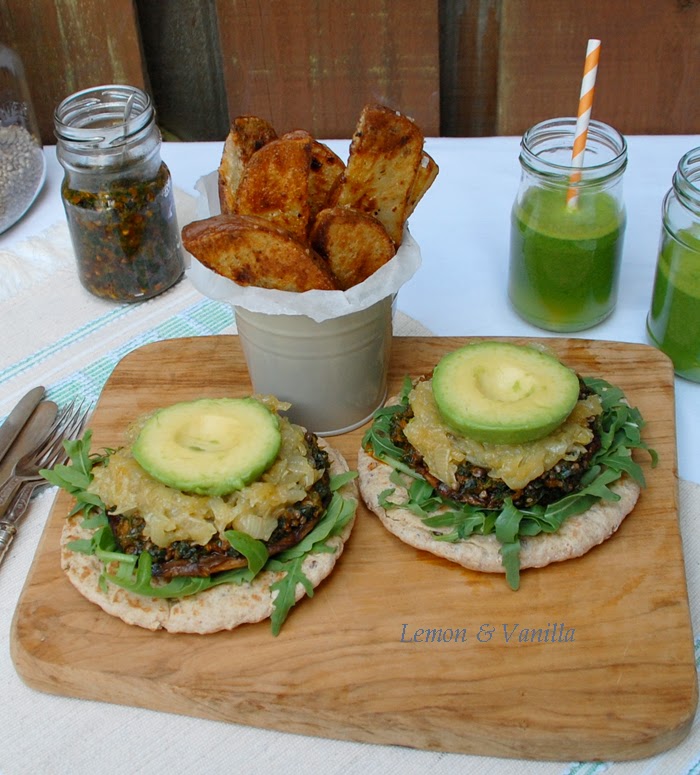
Open grilled portobello sandwich with sun dried tomato, kale and hemp pesto accompanied by a green juice and crispy baked fries / Sanduiche aberta de cogumelo portobello grelhado, com pesto de tomate seco, couve e sementes de cânhamo, acompanhada por sumo verde e batatas estaladiças assadas no forno.


Sometimes I think of turning vegetarian, but as soon as I think about a good fillet of grilled fish, clams, prawns and even a good grilled or fried steak - especially my mum's and the sauce she makes for them which I never get right - that idea fades straight away.
There's nothing new about the fact that I love food and I love to eat it right?
So, when I agreed with Maria to participate in her "healthy recipes" challenge, I was not concerned at all about what was I going to prepare.
Here at home, we love to try every type of food and experiment with new and different ingredients and flavours.
Fish, meat, vegetarian, vegan, we eat everything we fancy or whatever I prepare and even the kids are not fussy eaters and they are always keen to try different types of food.
For us, the important thing is to eat whatever we want, without fanaticisms, trends or fads and like everything else in life, everything is ok, as long as it is balanced.
So, out of one of my favourite books of the moment, this is the recipe/meal that I prepared for Maria's "healthy recipes" challenge.
Hope she likes it as much as we liked it here at home.


ingredients for the mushrooms (serves 2):
2 portobello mushrooms
2 tbsp balsamic vinegar
2 tbsp fresh lemon juice
2 tbsp olive oil (preferably extra virgin)
1 garlic clove, minced
1 tsp dried oregano
1 tsp dried basil
1/4 tsp fine sea salt (I used pink sea salt flakes from the Murray River - Australia)
1/4 tsp freshly ground black pepper
method:
Remove the stems from the mushrooms, scrape out the black gills with the help of a spoon and clean the mushrooms with a damp cloth.
In a large bowl, combine all the remaining ingredients. Add the mushrooms and toss them in the marinade.
Marinate the mushrooms for 30 to 60 minutes, turning them every 15 minutes.
You can leave the mushrooms to marinate overnight.
ingredients for the sun dried tomato pesto:
1 garlic clove, minced
1 cup lightly packed kale leaves, de-stemmed
1/4 cup sun dried tomatoes in oil, drained
1/4 cup hemp seeds
1 tbsp fresh lemon juice
1 tbsp olive oil
1/4 tsp fine sea salt (I used pink sea salt flakes from the Murray River - Australia)
method:
Put all the ingredients in a food processor with 2 tbsp of water and process until smooth.
This pesto will be to much for this recipe, so you can keep the remaining pesto in an airtight container in the fridge for up to 1 week and it can be used in sandwiches, wraps or with pasta.
toppings (optional):
caramelised onions - If using, simply cook 1 finely sliced onion over medium heat with 1 tbsp of olive oil until golden. It can take around 30 minutes.
avocado slices
kale or lettuce leaves (I used rocket)
sliced tomatoes (I didn't use)
to finish and assemble:
Grill the mushrooms for 4 to 5 minutes per side, on a preheated grill pan, over medium high heat.
Serve the mushrooms on a toasted bun (in the book it is served like a burger in a burger bun) or sliced up in a lettuce wrap.
I served mines as an open sandwich over multi seed and cereal pitta bread.
Top with a generous amount of the pesto and the toppings of your choice.
Serve the sandwiches with the crispy potato wedges and the green juice.


ingredients for the potato wedges:
2 large baking potatoes (about 450g)
1 tbsp arrowroot
1 tbsp grapeseed oil (I used olive oil)
1/2 tsp fine sea salt (I used pink sea salt flakes from the Murray River - Australia)
freshly ground black pepper
seasonings such as garlic powder, chilli powder, etc.
method:
Pre heat the oven to 220ºC and line a baking tray with baking paper.
Wash and dry the potatoes and quarter them lengthwise.
Slice each quarter in half or in thirds, depending on the potato size.
Place the arrowroot inside a plastic bag and add the potatoes. Shake the bag vigorously until the potatoes are coated. Add the olive oil and shake again.
Put the potatoes on the prepared baking tray spacing them apart. Sprinkle with the salt and pepper and your choice of seasonings.
Bake for 15 minutes, then flip the potatoes and bake for a further 10 to 20 minutes, or until golden and cooked through.
Serve immediately as the potatoes tend to loose their crispiness with time.
ingredients for the green juice (makes 2 cups - 500ml):
1 cucumber, peeled and roughly chopped
4 small kale leaves, roughly chopped
1 apple, cored and roughly chopped
1 pear, cored and roughly chopped
1 or 2 tbsp fresh lemon juice
method:
In a blender, combine all the ingredients with 125ml water and blend until smooth.
Strain the juice through a sieve, discard the pulp and serve.
__________________


Ás vezes penso em tornar-me vegetariana,  mas assim que penso num peixinho grelhado, em mariscos, bivalves e até num bom bife grelhado ou frito à moda e com o molhinho da minha mãe (que eu nunca consigo reproduzir), essa ideia logo se desvanece.
Que eu adoro cozinhar e adoro comida, não é novidade para ninguém certo?
Quando combinei com a Maria participar no seu desafio receitas saudáveis, não fiquei a pensar "ai, ai, o que é que vou preparar...", pois aqui em casa tanto se come carne, como peixe, como, se nos apetecer, somos vegetarianos por uma semana ou mais.
Para nós, o importante é comermos o que nos apetece, sem fanatismos, modismos ou tendências e, essencialmente, o que se come cá em casa, não está dependente do que é que vai ou não ficar bonito no blogue.
Gostamos de experimentar sabores e ingredientes novos e diferentes e se o resultado final for uma refeição saudável tanto melhor, caso contrário, desde que não haja exageros e excessos, tudo na vida é aceitável, inclusive as comidas pecaminosas, desde que haja equilíbrio.
Assim sendo, retirada de um dos meus livros preferidos do momento, esta é a receita, ou melhor, a refeição, que levo ao desafio receitas saudáveis da Maria e espero que ela a aprecie tanto, como nós aqui em casa a apreciámos


ingredientes para os cogumelos (para 2 pessoas):
2 cogumelos portobello grandes
2 colheres sopa de vinagre balsâmico
2 colheres sopa de sumo de limão
2 colheres sopa de azeite extra virgem
1 dente de alho, bem picado
1 colher chá de oregãos secos
1 colher chá de manjericão seco
1/4 colher chá de sal de mesa fino (eu usei flocos de sal rosa do Murray River - Austrália)
1/4 colher chá de pimenta preta moída na altura.
preparação:
Remover os pés dos cogumelos e com a ajuda de uma colher, raspar as brânquias castanhas do interior dos cogumelos.
Limpar os cogumelos muito bem com um pano húmido, para retirar impurezas e sujidades.
Numa taça grande, combinar os restantes ingredientes.
Colocar os cogumelos dentro da taça e envolvê-los na marinada.
Deixar marinar por 30 a 60 minutos, virando-os a cada 15 minutos, ou deixar de um dia para o outro.
ingredientes para o pesto de tomate seco:
1 dente de alho, bem picadinho
1 chávena de couve tipo portuguesa, sem talo
1/4 de chávena de tomates secos conservados em óleo, escorridos
1/4 chávena de sementes de chânhamo
1 colher sopa de sumo de limão
1 colher sopa de azeite extra virgem
1/4 colher chá de sal de mesa fino (eu usei flocos de sal rosa do Murray River - Austrália)
preparação:
Colocar todos os ingredientes no copo de um robot de cozinha, juntamente com 2 colheres de sopa de água e processar até obter uma pasta.
Esta quantidade de pesto é demais para esta receita, mas pode ser guardado num recipiente de fecho hermético e conserva-se no frigorífico por cerca de 1 semana. Pode ser usado em sandes, wraps e pratos de massa.
toppings (opcionais):
cebola caramelisada - se quiser utilizar, basta cozinhar num tacho sobre lume médio a brando, uma cebola cortada em fatias muito fininhas, juntamente com 1 colher se sopa de azeite.
Normalmente, a cebola demora cerca de 30 minutos até ficar caramelisada mas sem muita cor.
fatias ou rodelas de pera abacate
couve tipo portuguesa ou alface (eu usei rucula)
rodelas de tomate (eu não usei)
para finalizar e montar as sanduíches:
Aquecer bem um grelhador e, sobre lume médio a alto, grelhar os cogumelos por cerca de 4 a 5 minutos de cada lado ou até estarem tenros.
Servir os cogumelos sobre pão de hamburguer torrado (é como hamburguer que é servido no livro), ou fatiados e servidos sobre folhas de alface (tipo wrap).
Eu servi os meus como sanduíches abertas, sobre pão de pitta de sementes e cereais.
Cobrir os cogumelos com uma boa dose do pesto e com os toppings escolhidos.
Servir acompanhados das batatas e do sumo verde.


ingredientes para as batatas no forno:
2 batatas grandes para assar (cerca de 450g)
1 colher sopa de araruta ou de farinha Maizena
1 colher sopa de óleo de semente de uva (eu usei azeite)
1/2 colher chá de sal (eu usei flocos de sal rosa do Murray River - Austrália)
pimenta preta moída na altura
temperos à escolha, tais como, piripiri em pó, alho em pó, etc.
preparação:
Aquecer o forno a 220ºC e forrar um tabuleiro largo com papel vegetal.
Lavar as batatas e secá-las.
Cortar as batatas em quartos no sentido do comprimento e cortar cada quarto em 2 ou 3, dependendo do tamanho das batatas.
Colocar a araruta ou a Maizena num saco plástico. Adicionar as batatas e chocalhar bem o saco, por forma a que as batatas fiquem bem envoltas na araruta.
Adicionar o azeite ao saco e voltar a chocalhar.
Colocar as batatas no tabuleiro preparado, espaçando-as, para que possam ficar bem estaladiças.
Temperar as batatas com o sal, a pimenta e os temperos escolhidos.
Levar ao forno por 15 minutos e ao fim desse tempo virar as batatas.
Assar por mais 10 a 20 minutos, ou até as batatas estarem douradas, cozidas e crocantes.
Servir de imediato, pois estas batatas têm tendência a perder o crocante muito rapidamente.

ingredientes para o sumo verde (para 2 copos - 500ml):
1 pepino, descascado e picado grosseiramente
4 folhas de couve, tipo portuguesa, picadas grosseiramente
1 maçã, descaroçada e picada grosseiramente
1 pêra, descaroçada e picada grosseiramente
1 ou 2 colheres de sopa de sumo de limão
preparação:
Num copo liquidificador, colocar todos os ingredientes, juntamente com 125ml de água.
Processar muito bem e coar o sumo sobre um coador.
Descartar a polpa e servir o sumo.

Recipe / Receita: