Showing posts with label Dried fruits and/or nuts / Frutos secos.. Show all posts

2 September 2017

Crispy Chicken, Curried Spelt Salad and Raita / Frango assado, com Salada de Espelta de Caril e molho Raita.


This is a fabulous recipe that I made a couple of weeks ago and that was very delicious.
Actually, the spelt salad was a delightful surprise and I highly recommend it and if you leave out the chicken, this can easily be transformed onto a vegetarian or vegan meal.
I used Sandra curry powder mixture in this recipe. A homemade mixture that is so so fantastic, that since Sandra offered me a jar of her curry powder for the first time, I never went back to shop bought curry powder again.
Sandra loves her spices and all the spice mixtures she makes are amazing. I've already told her that she could be rich and famous selling her spices because she really is a "Spice Queen"!
This recipe is from Tom Kitchin new book "Meat & Game". About Chef Tom Kitchin, I've already told you here how much I love this Chef!
As for the book, the name says it all. A book full of very mouthwatering meat and game recipes and this one was the very first one I tried and we all loved it.

22 February 2017

Rose and Pistachio Granola / Granola com rosas e pistachios.


Today and because I'm in a kind of "rose recipes" mood, I'm sharing the first recipe from Nina Olsson AMAZING book "Bowls of Goodness".
This is the first recipe I'm sharing here on the blog, but not the first I made from Nina's book. No! I already made lots of delicious recipes, that I'll be sharing here soon.
Nina's book is the most delightful vegetarian (with vegan and gluten free options) book I have.
You know the kind of book that you just want to be in the kitchen and cook your way through it? Well, Nina's book is one of that kind...
"Nina's book IS NOT just another "avocado on toast" or average vegetarian cook book and believe me, because I have over 600 cookbooks and a good share of them are vegetarian and vegan.
Bowls of goodness is a thoughtful book, full of captivating images, colourful and appetising recipes. Balanced and very well written recipes that makes me (a meat eater trying to eat less meat), become vegetarian!
I got my copy on Saturday and honestly, since then, I can't stop reading it or cooking from it. One, after the other, I just want to cook all the recipes from the book and I'd say that there's no better sign of how good a book is.
Do I recommend it?
Even for meat eaters like myself?
YES! A 100%!!"
So, today, the recipe I'm sharing with you, is Nina Olsson, Bowls of Goodness, Rose and Pistachio Granola.
A granola that, after the first time I made it, quickly became the favourite one here at home and I'm making it weekly now.
Oh, and by the way..., just wait until I share with you the next recipe which will be Nina's Savoury Granola...
You'll be totally in love with it but..., you have to wait a few more days...

10 January 2017

Espresso Granola / Granola de Café.


After all the December excesses, we all need a little food cleansing this month and so, for January and the most needed detox and clean start, I'm leaving you with this delicious and very flavoursome granola.
The recipe is from Donna Hay "Life in Balance" cookbook and the coffee flavour is a very pleasant surprise.

21 June 2016

Pearl barley, roasted cauliflower and cranberry salad / Salada de cevadinha, couve flor assada e arandos.


Another delicious, vegetarian salad that, was absolutely divine and has to be shared.
The humble and underrated cauliflower, after being rubbed with aromatic spices and roasted, just gets incredibly delicious and elevated to a total new level, either in texture and flavour.
The recipe, is from Simmone Logue beautiful book "In the Kitchen", from which, I already posted this amazing and delicious Victoria Sponge.
ingredients (serves 4):
200g pearl barley
1 small cauliflower, cut into chunky pieces
2 tsp ground turmeric
1 tbsp ground sumac
2 tbsp olive oil
2 tbsp chopped dill
4 tbsp chopped mint
150g parsley, chopped
30g walnuts, toasted and chopped
75g pistachio nuts, toasted and chopped
75g dried cranberries
1 pomegranate, seeded
100g feta cheese, crumbled
for the dressing:
zest and juice of 1 lemon
3 tbsp pomegranate molasses
3 tbsp olive oil
1/4 garlic clove, crushed
method:
Cook the pearl barley over medium heat, for 40 minutes in 500ml water, until the water has been absorbed. set aside yo cool.
Preheat the oven to 180ºC.
Line a baking tray with baking paper.
In a bowl, combine the cauliflower, turmeric, sumac and the olive oil.
Spread the cauliflower over the baking tray and roast for 15 to 20 minutes, or until the cauliflower is a little caramelised.
Remove from the oven and leave to cool.
Place the cooled cauliflower and the barley in a serving dish.
Add the herbs, nuts and cranberries.
Mix all the dressing ingredients together and season to taste with sea salt.
Toss the salad with enough dressing to moisten it.
Scatter with the feta cheese and the pomegranate seeds just before serving.

__________________

Embora cá em casa ninguém seja vegetariano, gostamos (só pelo prazer de testar e saborear diversidade), de fazer refeições vegetarianas, sempre que nos apetece e foi o caso, quando decidi fazer esta salada, toda ela recheada de texturas, cor e variedade.
A couve flor, normalmente renegada e desvalorizada, é aqui elevada a um nível completamente superior, quando envolvida em aromáticas especiarias e assada no forno.
A receita, do livro lindo da Simmone Logue, o "In the Kitchen", do qual já aqui publiquei este maravilhoso Victoria Sponge, foi mais uma, testada, saboreada e muito apreciada.


ingredientes (para 4 pessoas):
200g cevadinha
1 couve flor pequena, separada em floretes
2 colher chá de curcuma (açafrão das Índias)
1 colher sopa de sumagre
2 colheres sopa de azeite
2 colheres sopa de aneto fresco picado
4colheres sopa de hortelã fresca, picada
150g salsa, picada
30g nozes, tostadas e picadas
75g pistachios, tostados e picados
75g arandos secos
sementes de 1 romã
100g queijo feta, esfarelado
para o molho:
raspa e sumo de 1 limão
3 colheres sopa de melaço de romã
3 colheres sopa de azeite
1/4 de dente de alho, esmagado
preparação:
Num tacho sobre lume médio, cozer a cevada em 500ml de água, por cerca de 40 minutos,  ou até a cevada estar cozida mas al dente e a água ter evaporado toda. Reservar e deixar arrefecer.
Aquecer o forno a 180ºC e forrar um tabuleiro com papel vegetal.
Numa taça, misturar bem a couve flor, juntamente com a curcuma, o sumagre e o azeite.
Espalhar a couve flor no tabuleiro e levar ao forno por 15 a 20 minutos, ou até esta estar ligeiramente caramelizada.
Retirar o tabuleiro do forno e deixar arrefecer.
Entretanto, misturar bem todos os ingredientes do molho e temperar a gosto, com flor ou flocos de sal.
Colocar a couve flor e a cevada num prato de serviço.
Adicionar os frutos secos, ar ervas aromáticas frescas e os arandos e envolver tudo muito bem, com cerca de metade do molho.
Polvilhar com as sementes de romã e com o queijo feta esfarelado e servir.

Recipe / Receita:

1 June 2016

Chocolate granola and Rhubarb & vanilla compote / Granola de chocolate e Compota de ruibarbo e baunilha.


Today I'm leaving you with two delicious recipes.
The first one, a delicious chocolate granola that is super easy and quick to make and that is very appreciated here at home.
Actually, is the one the kids are now asking to make all the time. I just use whichever dried fruits, nuts or seeds that I have at home and it's like a different granola every time.
The recipe is from Rosa, Be Nice Make a Cake, gorgeous "Chocolate Notebook". A delightful Notebook, full of chocolaty delights.
The second, is a April Carter recipe and it's from her little book "trEATs". A book that I truly treasure because, although it's a very small book, is packed full of brilliant suggestions.
A very delicious rhubarb compote that is delicious over yoghurt or with whatever you fancy it.
ingredients for the chocolate granola:
400g rolled oats (I used rye flakes and oats)
100g seeds (sunflower seed, sesame seeds, pumpkin seeds, flaxseeds)
1 tbsp ground cinnamon
60ml vegetable oil
60ml honey
2 tbsp coconut oil
2 tbsp cocoa powder
1 tsp vanilla extract or seeds scrapped from 1 vanilla pod
zest from 1 orange
grated chocolate, coconut flakes (optional) and nuts, to taste
method:
Heat oven to 180ºC.
Mix the oats, seeds and cinnamon in a large bowl.
Put the honey, vegetable oil, coconut oil, cocoa powder, orange zest and vanilla in a saucepan and heat until melted.
Add the melted ingredients to the bowl containing the oat mixture and mix well.
Tip the granola onto two baking sheets lined with baking paper and spread evenly.
Bake for 15 minutes, then mix with a wooden spoon and bake for another 10 to 15 minutes more. Remove and scrape onto a flat tray to cool.
When cool, mix in the grated chocolate, the chosen nuts and, if using, the coconut flakes.
Store in an airtight container.
Serve with cold milk or yogurt.
ingredients for the rhubarb and vanilla compote (fills 2 x 250ml jars):
500g rhubarb, trimmed and chopped into 5cm chunks
250g caster sugar
seeds scrapped from 1/2 vanilla pod
method:
Place the rhubarb, sugar and vanilla seeds in a saucepan with a lid.
Stir the mixture to combine the ingredients and set aside for 20 minutes.
Heat the mixture in the saucepan over a high heat.
Bring to the boil and then simmer over a low heat, shaking the pan occasionally, for about 10 to 15 minutes, or until the rhubarb is tender but still keeps its shape.
Allow the mixture to fully cool, then divide between 2 clean jars.
Seal and store in the fridge and eat within a week.

__________________

Hoje deixo-vos, não uma, mas duas receitas maravilhosas.
A primeira, uma granola de chocolate divina (que cá em casa tem sido feita vezes sem conta, utilizando diferentes combinações de sementes e frutos secos) do Caderno das Receitas com Chocolate da nossa Rosa (Be Nice, Make a Cake) e a outra, uma receita de compota de ruibarbo e baunilha, absolutamente maravilhosa, do livrinho lindo, pequenino, mas recheado de maravilhas, da April Carter, o "trEATs".
A compota pode ser servida com iogurte, sobre granola, ou até comida à colherada. Usem a vossa imaginação e gosto pessoal e deliciem-se, pois é maravilhosa!


ingredientes para a granola de chocolate:
400g flocos de aveia (eu usei uma mistura de flocos de aveia e flocos de centeio)
100g sementes (sésamo, girassol, abóbora, linhaça)
1 colher sopa de canela em pó
60ml óleo vegetal
60ml mel
2 colheres sopa de óleo de coco
2 colheres sopa de cacau em pó (da melhor qualidade possível)
1 colher chá de extracto de baunilha, ou sementes raspadas de uma vagem de baunilha
raspa de 1 laranja
chocolate ralado, flocos de coco (eu usei mas não consta da receita original) e frutos secos a gosto
preparação:
Aquecer o forno a 180ºC.
Numa taça, misturar a aveia, a canela e as sementes.
Num tacho, aquecer os óleos, o mel, o cacau em pó, a raspa da laranja e a baunilha, mexendo, até tudo estar derretido.
Adicionar esta mistura à mistura da aveia e envolver tudo muito bem.
Distribuir a granola por dois tabuleiros forrados com papel vegetal, espalhando bem.
Levar ao forno por 15 minutos, retirar do forno, mexer bem com uma colher de pau e voltar a colocar no forno por mais 10 a 15 minutos. Cuidado para não queimar.
Retirar do forno e transferir a granola para um tabuleiro frio e deixar arrefecer.
Depois de fria, adicionar o chocolate ralado, os flocos de coco (caso usem) e os frutos secos a gosto e envolver tudo muito bem.
Colocar em frascos de fecho hermético e servir com leite, iogurte, ou outras combinações a gosto.


ingredientes para a compota de ruibarbo e baunilha (enche 2 frascos de 250ml cada):
500g ruibarbo, arranjado e cortado em pedaços de 5cm de comprimento
250g açúcar refinado branco
sementes raspadas de 1/2 vagem de baunilha
preparação:
Colocar o ruibarbo, o açúcar e a baunilha num tacho com tampa.
Mexer tudo muito bem e reservar por 20 minutos.
Findo esse tempo, colocar o tacho ao lume e, sobre lume alto, aquecer até levantar fervura.
Quando levantar fervura, baixar o lume e cozinhar por cerca de 10 a 15 minutos, abanando o tacho de vez em quando. O ruibarbo deve ficar macio, mas sem ficar completamente desfeito.
Desligar o lume e deixar a mistura arrefecer completamente.
Depois de fria, dividir a compota por dois frascos esterilizados e de fecho hermético e conservar no frigorífico.
Esta compota deve ser consumida no prazo de 1 semana.

Recipes / Receitas:
Granola: Caderno de Receitas com Chocolate - Rosa Cardoso - Be Nice, Make a Cake.
Compote / Compota:

26 March 2016

Chocolate Simnel cake / Bolo Simnel de chocolate.


Easter is not Easter without a Simnel cake right?
Well, I never made a Simnel cake before...
This was my very first time and I'm regretting that I waited so long to make one.
As you read here, this month's Sweet World Challenge is all about Easter and there are two options up for grabs: Hot Cross Buns and Simnel cake.
Although I made the Hot Cross Bun Loaf to introduce this month's the theme, I couldn't let go the opportunity to make both and that's why I decided to make the Simnel cake too.
The recipe is from Delicious magazine and it's a slightly different Simnel cake as it has chocolate in it which is not very traditional.
I decided to give it even more twists and so, I adapted the recipe a bit to my taste.
  • The original recipe calls for a hazelnut marzipan but I made the traditional almond one.
  • I also decided, as Susana did with her's, to cut the cooled cake in half and put a disc of the marzipan in between the cake halves.
  • The original recipe doesn't have the top disc of marzipan that I also decided to add in order to make it a bit more traditional.
  • Before rolling the marzipan balls for the top, I added 2 very small drops of yellow food colouring to my marzipan in order to give a different colour to the top decoration.
  • Read this article if you want to know more about the Simnel cake and its History.
As I'm going for a few days of holidays, there'll be no posts here on the blog for a few days and therefore, I wish you all a very Happy Easter.
Saying that, here is my adaptation of the Simnel cake.


for the marzipan (recipe that I also used in this tart):
225g icing sugar, plus at least 3 tbsp for rolling
175g caster sugar
350g ground almonds
2 large free range eggs
1/2 tsp almond extract
1 tsp freshly squeezed lemon juice
method:
Sift the icing sugar into a large bowl and stir in the caster sugar and almonds. 
Beat the eggs with the almond extract and lemon juice in a separate bowl.
Stir into the dry ingredients with a large spoon until the mixture begins to come together. Use your hands to continue combining the mixture into a stiff, but pliable paste.
Dust the work surface with more sifted icing sugar and knead the marzipan for 1 minute or 2, until smooth.
Return to the bowl, cover tightly with cling film and leave to stand for 1 to 2 hours before using. This will allow the almonds to swell and absorb some of the moisture from the egg mixture (note that this recipe contains raw eggs).
Dust a sheet of baking paper with sifted icing sugar.
Divide the marzipan into three equal balls.
Take one of the balls and roll out on the paper into a circle the size of the cake tin and 5mm thick. Place the cake tin on top of the rolled marzipan and use it as a template to cut out a circle around.
Repeat with the second ball of the marzipan.
Form the remaining marzipan ball into 11 balls to represent all the Apostles (minus Judas) or 12, to represent the 11 Apostles and Jesus.
Each of the balls needs to weigh between 16 to 20g so you will have a little marzipan leftover.
Wrap the discs and balls of marzipan individually and tightly in cling film to prevent them drying out and put them in the fridge until needed.


ingredients for the cake (serves 12 to 16):
120g unsalted butter, softened, plus extra to grease
100g caster sugar
300g dark brown muscovado sugar
135g (when drained) cherries in kirsch
100g full fat greek yoghurt
4 large free range eggs
320g self raising flour
80g cocoa powder
1 tsp bicarbonate of soda
200ml cherry juice (or pomegranate juice)
250g dried sour cherries
method:
Heat the oven to 170ºC.
Grease and line the base and sides of a deep 23cm cake tin.
Put the butter, sugars, drained cherries and yoghurt in a food processor.
Whizz until mixed, then add the remaining ingredients, except the sour cherries, and whizz until you have a smooth batter.
Add the dried sour cherries and pulse until just incorporated.
Pour the batter into the prepared tin, then bake for 90 minutes or until a skewer pushed into the middle comes out clean.
When the cake comes out of the oven, allow it to cool completely in the tin.


for the ganache:
100g dark chocolate (70%)
100ml double cream
50g Nutella
method:
Roughly chop the chocolate and put it in a heatproof bowl with the cream.
Set the bowl over a pan of simmering water (don't let the bowl touch the water) and stir together until you have a glossy ganache.
Remove from the heat and beat in the Nutella.
Leave to cool at room temperature until spreadable.


to assemble the cake:
Cut the cake in half horizontally.
Put one half of the cake on a serving plate and spread the top with a thin layer of the ganache.
Place one disc of the marzipan on top, pressing gently, so it sticks to the ganache.
Spread the top of the marzipan disc with another thin layer of the ganache and put the second half of the cake on top. Press it down gently so all the layers stick together.
Spread the top of the cake with another thin layer of the ganache and top it with the second marzipan disc, pressing again, very gently.
Cover the marzipan with the remaining ganache and place the 11 marzipan balls around the edge of the cake.
Dust the top of each marzipan ball with cocoa powder.

__________________

Dizem que Páscoa não é Páscoa sem um bolo Simnel.
Na verdade, até agora, nunca tinha feito nenhum Simnel e arrependo-me, mas já fica de lição para Páscoas futuras...
Como puderam ler aqui, o tema desta edição do Sweet World tem como opções, fazer Hot Cross Buns que foi o que fiz, ou de fazer um bolo Simnel.
Ora eu, como uma das mentoras do projecto, não podia perder a oportunidade de fazer ambos e fiz os Hot Cross Buns em forma de pão para apresentar o tema (e deixem que vos diga, eram maravilhosos) e decidi fazer o Simnel também, pois tinha muita curiosidade em relação a este bolo lindo, cuja história podem ler aqui, no cantinho da minha "partner" Susana.


A receita que hoje vos trago é da revista Delicious deste mês de Março e o que nela me seduziu foi o aspecto do bolo que, fugindo um bocadinho ao tradicional, leva chocolate.
Ainda assim, decidi dar-lhe alguns twists, por forma a aproximá-lo um bocadinho mais do Simnel tradicional, ou seja:
  • a receita original utiliza um massapão de avelã, mas eu decidi usar o mesmo massapão de amêndoa que havia feito (pela primeira vez) para esta tarte do Dia da Mãe.
  • nas receitas dos bolos Simnel mais tradicionais, é usual ver-se um disco de massapão que é colocado entre camadas da massa crua do bolo e que depois vai a cozer ao forno, desfazendo-se na massa do bolo, mas como eu adorei a ideia da Susana de colocar esse disco de massapão no meio do bolo depois de este estar cozido e frio, resolvi aplicar essa técnica ao meu Simnel, pois acho que fica mais bonito.
  • na receita original do bolo, é suprimido o disco característico e tipico, de massapão no topo do bolo, característica que eu decidi adaptar e incorporar na receita.
  • uma nota á parte e por questões de segurança, atenção aos ovos que utilizam, pois esta receita contem ovos crus no massapão.
  • antes de transformar a (3ª) bola de massapão nas 11, 12 ou 13 bolinhas que vão decorar o bolo, adicionei-lhe duas gotinhas mínimas de corante culinário amarelo, só para lhe dar um toque diferente dos discos de massapão do centro e topo.
O resultado final é um bolo magníficamente delicioso. Denso em termos de textura, mas ao mesmo tempo, húmido e muito, muito viciante.

Posto isto e antes de vos deixar a receita do bolo, já com as referidas adaptações, desejo a todos os que por aqui passam, uma Santa e muito Feliz Páscoa.
Vou estar de férias por uns dias e com tal, o blogue também estará de férias, mas brevemente estarei de volta com muitas novidades deliciosas, algumas delas já agendadas.


para o massapão:
225g açúcar em pó + extra para a bancada
175g açúcar refinado branco
350g amêndoa ralada (moída)
2 ovos grandes (L), de preferência biológicos
1/2 colher chá de extracto de amêndoa
1 colher chá de sumo de limão
preparação:
Peneirar o açúcar para uma taça.
Adicionar o açúcar e as amêndoas e mexer tudo muito bem.
Numa taça à parte, bater os ovos com o extracto de amêndoa e o sumo do limão.
Adicionar os ingredientes líquidos aos sólidos e misturar tudo muito bem, até que a mistura comece a formar uma bola.
Amassar até obter uma pasta consistente mas moldável.
Colocar o massapão sobre uma bancada bem polvilhada com açúcar em pó e amassar por 1 minuto ou 2, ou até esta estar macia.
Colocar o massapão na taça, cobrir com película aderente e refrigerar por, pelo menos, 1 a 2 horas.
Passado esse tempo, dividir o massapão em 3 bolas mais ou menos iguais.
Polvilhar com açúcar em pó a bancada ou uma folha de papel vegetal e estender uma das bolas, até obter um círculo com o diâmetro da forma do bolo e cerca de 5mm de espessura (colocar a forma em cima, a fim de servir de molde).
Repetir este processo com a segunda bola de massapão.
Com a terceira bola de massapão, formar bolas com cerca de 16 a 20g cada. Aqui é como decidirem, ou formam 11 bolas, representando os 11 Apóstolos, excluindo o Judas, ou formam 12 bolas, representando os 11 Apóstolos citados anteriormente mais Jesus ou, caso decidam dar uma segunda oportunidade ao Judas, formem 13 bolas... (eu só contei com os 11 Apóstolos e Jesus. Detesto traidores, lol).
Enrolar, os discos e as bolas, separadamente, em película aderente e reservar no frigorífico até serem necessários.


ingredientes para o bolo (para 12 a 16 pessoas):
120g manteiga sem sal, amolecida + extra para untar a forma
100g açúcar refinado branco
300g açúcar mascavado escuro
135g (peso escorrido) de cerejas em kirsch
100g iogurte grego (total ou gordo)
4 ovos grandes (L), de preferência biológicos
320g farinha de trigo branca com fermento
80g cacau em pó
1 colher chá de bicarbonato de sódio
200ml sumo de cereja (ou de romã) - tipo Compal
250g cereja amarga seca ou podem usar mirtilos ou arandos secos
preparação:
Aquecer o forno a 170ºC.
Untar muito bem e forrar com papel vegetal, a base e as paredes de uma forma profunda, com cerca de 23cm de diâmetro.
No copo do robot de cozinha, colocar a manteiga, os açúcares e o iogurte e processar até tudo estar bem incorporado.
Adicionar os ingredientes restantes, à excepção da cereja amarga seca e voltar a processar, até obter uma mistura cremosa.
Adicionar a cereja amarga seca e pulsar, só para incorporar.
Deitar a mistura na forma preparada e levar ao forno por cerca de 90 minutos, ou até um palito inserido no meio do bolo sair completamente limpo.
Quando o bolo estiver cozido, retirá-lo do forno e deixá-lo arrefecer completamente na própria forma.


para o ganache:
100g chocolate preto (70%)
100ml natas para culinária
50g Nutella
preparação:
Picar o chocolate grosseiramente e colocá-lo, juntamente com as natas, numa taça resistente ao calor.
Colocar a taça sobre um tacho de água a ferver, sem que a taça toque na água e mexer até o chocolate estar derretido e a mistura estar brilhante e macia.
Retirar a taça do lume, adicionar a Nutella e mexer tudo muito bem até obter uma mistura homogénea.
Deixar a mistura arrefecer á temperatura ambiente, até ter uma consistência "barrável".


para montar o bolo:
Cortar o bolo ao meio, por forma a obter dois discos.
Colocar um dos discos de bolo sobre um prato de serviço e barrar o topo com uma camada fininha de ganache.
Colocar um dos discos de massapão por cima, pressionando delicadamente, por forma a colar o massapão ao ganache.
Barrar a superfície do disco de massapão com outra camada fininha de ganache e colocar o segundo disco de bolo em cima.
Barrar esse segundo disco de bolo com mais uma camada fininha de ganache e colocar-lhe o segundo disco de massapão em cima, pressionado delicadamente uma vez mais.
Cobrir todo o topo com o ganache restante e decorar com as bolas de massapão.
Caso queiram incluir Jesus, a bola respectiva será colocada no centro do bolo, enquanto que as bolas que representam os Apóstolos, são colocadas a toda a volta da extremidade do bolo.
Polvilhar as bolas de massapão com cacau em pó.

Recipes / Receitas:
Marzipan / Massapão: The Hairy Bikers.
Cake and Ganache / Bolo e Ganache: Adapted from Delicious magazine (John Whaites) - March 2016.

20 March 2016

Hot Cross Buns, Easter and the Sweet World / O Sweet World, a Páscoa e uns Hot Cross Buns.


Hot Cross Buns vs. Simnel Cake


Time just flies by and it's time for another Sweet World Challenge.
We started the first edition of the Sweet World in the UK with the Queen of Puddings, last month we went to America with the Brooklyn Blackout Cake and this month we decided to go back to the UK for some Easter classics.
Yes, this month's theme is all about Easter.
There's two Easter classics in the UK that we love and, because we couldn't decide between the two of them, we decided that, this month, you'll have two choices.
You can choose between making Hot Cross Buns or a gorgeous Simnel Cake.
Either or both, the choice is yours!
I baked Hot Cross Buns and Susana baked the Simnel Cake and we are showing you both, so you can choose which one you want to bake.
If you choose the Hot Cross Buns, just keep on reading this post.
If you choose the Simnel Cake, just head up to Susana's blog and find out everything you need to know about this gorgeous cake.

Saying that, here are the rules:
  • You have until the 20th of April to make Hot Cross Buns or a Simnel Cake (or both if you wish).
  • That same day, 20th of April, Susana will let you know the theme for the next challenge.
  • If you're making the Hot Cross Buns, you'll have to leave the link for your participation here in this post in order to be featured in the round up.
  • If you choose to make the Simnel Cake, you'll have to leave the link for your participation at Susana's blog.
  • There'll be 2 round ups this month.
  • The Hot Cross Bun round up here, on my blog and the Simnel Cake round up on Susana's blog.
  • The round ups will be posted on both blogs on the 25th of April.

Hot Cross Buns: (facts and curiosities copied from this post)
  • A traditional hot cross bun is a yeasted sweet bun that's lightly spiced and studded with raisins or currants, then marked on top with a cross that's either piped in icing or etched into the dough.
  • While hot cross buns are now sold and enjoyed throughout the year, they were once reserved for Good Friday alone.
  • A 12th century monk introduced the cross to the bun.
  • The origins of hot cross buns may go back as far as the 12th century.
  • According to the story, an Anglican monk baked the buns and marked them with a cross in honor of Good Friday.
  • Over time they gained popularity, and eventually became a symbol of Easter weekend.
  • Hot cross buns gained popularity in Elizabethan England.
  • Towards the end of the 16th century, Queen Elizabeth I passed a law limiting the sale of sweet buns to funerals, Christmas, and the Friday before Easter.
  • The English were deeply superstitious, believed the buns carried medicinal or magical properties, and were fearful of those powers being abused.
  • Some even believed that buns baked on Good Friday would never go stale.
  • As a way to get around the law, more and more people began baking these sweet buns at home. Not only did they grow in popularity, but the law became too difficult to enforce and was eventually rescinded.
  • There are also more than a few stories that indicate hot cross buns were baked on Good Friday for superstitious reasons.
  • One tale states that buns baked on this day and hung from the rafters of a home would ward off evil spirits in the coming year.
  • Another talks of these buns protecting sailors from shipwreck, while off at sea.
  • Another version mentions that sharing the bun with a loved one guarantees friendship in the coming year.
Hot Cross Buns

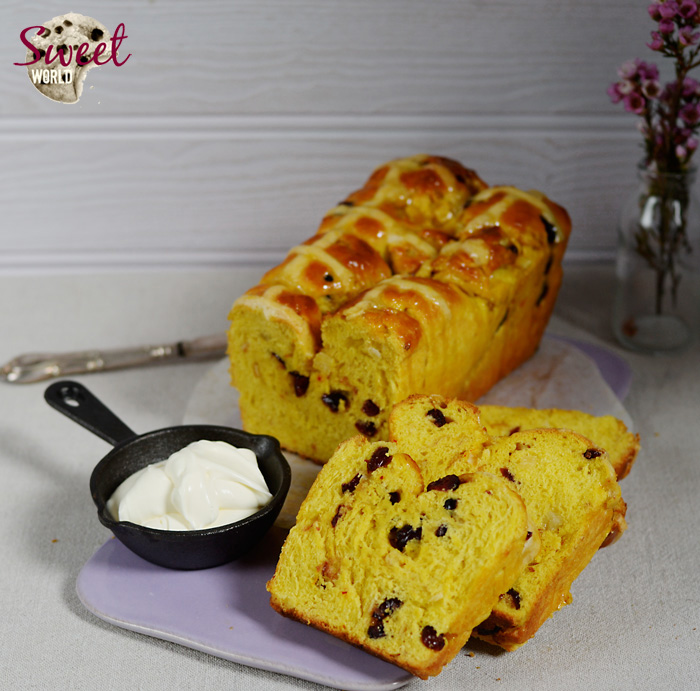
Last year I baked the buns in the traditional shape and you can find the recipe here but, this year (and here comes the twists that we are allowed each month), I couldn't resist this Hot Cross Bun Loaf spiced with saffron that is featured in the March 2016 issue of Delicious magazine.
To be truthful, I'm not a huge fan of Hot Cross Buns and that's why I'm so glad that I chose this recipe!!
Both, texture and flavour, are so amazing and perfect that, literally, I had to stop myself from eating the whole loaf!!


ingredients (serves 10 to 12):
1tsp saffron strands
3 tbsp warm water
500g strong white bread flour, plus extra to dust
1/2 tsp salt
75g caster sugar
10g dried yeast
175ml whole milk, warmed
2 medium eggs, free range, beaten
75g salted butter, softened, plus extra for greasing
sunflower oil, for greasing
75g each currants, raisins and chopped candied peel, mixed (I only used dried cranberries and a mix of the candied peel).
clotted cream, to serve (I served with creme fraîche)
method:
Heat a small frying pan over a medium high heat.
Add the saffron and shake it around for a few seconds until it darkens very slightly.
Tip into a mortar to cool, then grind into a fine powder with a pestle.
Add the 3 tbsp of the warm water and leave to cool.
Sift the flour, salt, sugar and yeast into a bowl and make a well in the centre.
Add the saffron water, warm milk, eggs and 75g of softened butter. Mix lightly with your fingers until everything comes together into a slightly sticky (but not wet) dough.
If the mixture is too dry add 1 extra tbsp of water (I didn't need to add that extra water).
Turn the dough out onto a lightly floured surface and knead for 10 minutes or until silky smooth.
Put the dough into a lightly oiled bowl, cover with clingfilm and leave to rise in a warm place for 1 and 1/2 to 2 hours until doubled in size.
I put my bowl in the fridge overnight!
Turn the dough out onto a lightly floured surface and knock out the excess air.
Sprinkle over some of the mixed dried fruit, knead it in, then repeat with the remaining dried fruit until everything has been incorporated.
Return the dough to the oiled bowl, re-cover and leave to rise for 1 hour more, or until doubled in size.
Butter the loaf tin.
Cut the dough into 10 even pieces and knead them into quite tall rounds.
Arrange the rounds, side by side, in the tin.
Cover with cling film or put the tin inside a clean plastic bag and leave to rise somewhere warm for 1 hour, or until the dough has risen to the top of the tin.
When the buns are almost ready, heat the oven to 180°C.
for the decoration:
25g plain flour
1 tsp sunflower oil
2 to 3 tbsp cold water
method:
Beat the ingredients in a mixing bowl to make a thick but pipeable batter and then spoon into a piping bag and set aside.
Take the dough out of the bag, then pipe crosses over the top of each dough ball.
Bake for 35 to 40 minutes or until golden.
for the glaze:
75ml fresh orange juice
2 tbsp caster sugar or clear honey
method:
When the loaf is nearly ready, simmer the glaze ingredients in a pan and boil to a thick syrup.
Remove the loaf from the oven, then brush with the glaze while hot.
Cool on a wire rack and serve sliced, topped with clotted cream (I served with creme fraîche).

__________________

O tempo voa e já vamos para a 3ª edição do nosso Sweet World!
A 1ª edição começou no Reino Unido com o Queen of Puddings.
Viajámos na 2ª edição até à América e propusemos-vos o Brooklyn Blackout Cake.
Nesta 3ª edição, voltamos ao Reino Unido.
Nada de tendencioso, simplesmente adoramos dois clássicos Britânicos para esta época da Páscoa.
Sim, já perceberam, o tema para esta 3ª edição do Sweet World tem a ver com a Páscoa.
Ora bem, estando nós tão pertinho da Páscoa, tanto eu como a Susana, estávamos muito indecisas entre Hot Cross Buns e Simnel Cake (os tais dois clássicos Britânicos).
Depois de muita dissertação sobre o assunto e de alterarmos o tema variadíssimas vezes, decidimos no final, propor-vos um duplo tema!
Sim, é verdade, duplo!!
Eu fiz Hot Cross Buns e a Susana, fez o Simnel Cake e por isso vos apresentamos ambas as opções.
Ambos são muito típicos desta época Pascoalina e vocês escolhem qual querem fazer.
Ou um, ou o outro, ou, se quiserem, ambos. A escolha é vossa!
Se escolherem os Hot Cross Buns, terão de deixar o link da vossa participação, aqui, neste post.
Caso se decidam pelo Simnel Cake, deixarão o link da vossa participação no post do blogue da Susana, onde poderão encontrar desde já, as descrições e características fundamentais do Simnel cake.


Assim sendo, vamos ás regras:
  • Têm até ao dia 20 de Abril para fazer os Hot Cross Buns ou o Simnel Cake (ou, como especificado acima, ambos, caso queiram).
  • Nesse mesmo dia, 20 de Abril, será, no blogue da Susana, lançado o tema para a 4ª edição deste fantástico Sweet World.
  • Se se decidirem pelos Hot Cross Buns e, caso queiram fazer parte do round up mensal, terão de deixar o link da vossa participação aqui, neste post.
  • Caso se decidam pelo Simnel cake, deixarão o vosso link no blog da Susana.
  • Caso queiram fazer os dois, deixarão um link em cada um dos posts dos blogues respectivos, no meu (para os Hot Cross Buns) e no da Susana (para o Simnel Cake).
  • Haverá 2 round ups nesta edição.
  • O round up dos Hot Cross Buns e o round up do Simnel cake.
  • Ambos os round ups serão publicados no dia 25 de Abril, cada um no seu respectivo blogue (aqui, no Lemon & Vanilla para os Hot Cross Buns e no Basta Cheio para o Simnel Cake).

Hot Cross Buns: (factos e curiosidades retirados deste post)
  • O tradicional Hot Cross Bun é composto por bolinhas de massa lêveda e doce, cuja composição engloba especiarias e frutos secos, nomeadamente, passas de uva e groselhas secas.
  • As bolinhas são decoradas com uma cruz no topo.
  •  Hoje em dia, é possível encontrar Hot Cross Buns à venda em supermercados o ano todo, enquanto que em tempos remotos, estas bolinhas eram consumidas apenas e unicamente na 6ª feira Santa.
  • As origens da cruz no topo das bolinhas, remetem a um monge no Século XII.
  • Reza a história que no Século XII, um monge Anglicano, terá confeccionado os Hot cross Buns, tendo-os marcado com uma cruz no topo, em homenagem à 6ª feira Santa.
  • Os ditos bolinhos foram-se tornando populares e ganhado fama, especialmente durante o reinado da rainha Elizabete I e tornaram-se num símbolo da Páscoa.
  • Estavam a tornar-se tão comuns e corriqueiras que, nos finais do Século XVI, a Rainha Elizabete i emitiu uma lei proibindo a venda ou confecção dos Hot Cross Buns, a não ser que fossem confeccionados especificamente para serem consumidos em funerais, Natal e 6ª feira Santa.
  • Aparentemente, os britânicos, sendo um povo muito supersticioso, acreditavam que os Hot Cross Buns tinham propriedades medicinais e mágicas e receavam que esses poderes estivessem a ser abusados e vulgarizados.
  • Era tal a crença que, alguns chegaram mesmo a acreditar que os Buns confeccionados na 6ª feira Santa, nunca ficariam duros.
  • Por forma a contornar a Lei instituida pela rainha Elizabete I, estes bolinhos começaram a ser cada vez mais confeccionado (secretamente) em casas particulares, o que fez com que a Lei fosse difícil de manter e, eventualmente, tivesse de ser banida.
  • Existem várias histórias que relatam que, supersticiosamente, os Hot Cross Buns só eram confeccionados na altura da Páscoa.
  • Há uma lenda que diz que os Hot Cross Buns confeccionados numa 6ª feira Santa e pendurados dentro de casa, espantariam os espíritos malignos até à próxima 6ª feira Santa.
  • Outra lenda diz que, confeccionados nesse dia (6ª feira Santa), os Hot Cross Buns protegeriam os barcos de naufragar.
  • Outra das lendas diz que, partilhar um Hot Cross Bun com um ente querido na 6ª feira Santa, protegeria a amizade entre essas duas pessoas durante o ano seguinte.

Hot Cross Buns

O ano passado, fiz, pela primeira vez, Hot cross Buns no formato tradicional e mais comum. Podem ver a receita que está publicada aqui.
Este ano (e aqui entram em acção os tais "twists" que podem dar ás vossas contribuições, sem com isso alterar as characteristics fundamentais do tema), optei por fazê-los em forma de pão.
Não consegui resistir a estes Hot Cross Buns, cuja receita vem na revista Delicious deste mês de Março e cujas alterações são o facto de serem confeccionados em forma de pão e aromatizados e tingidos com a especiaria mais cara do mundo, filamentos de açafrão!
Para vos ser honesta, Hot Cross Buns (e embora adore massas lêvedas), não estão no topo das minhas preferências e por isso, e ainda bem, decidi-me por esta receita magnífica pois, quer em termos de textura, quer em termos de sabor, estes Hot Cross Buns são tão maravilhosos e viciantes que, literalmente (e acreditem) tive de me obrigar a parar de os comer, senão, lá se tinham ido todos!!!
Vamos então à receita!!
ingredientes (para 10 a 12 porções):
1colher chá de filamentos de açafrão
3 colheres sopa de água a ferver
500g farinha de trigo branca para pão + extra para polvilhar
1/2 colher chá bem cheia de sal fino
75g açúcar refinado branco
10g fermento de padeiro seco
175ml leite gordo, aquecido
2 ovos médios (de preferência biológicos), ligeiramente batidos
75g manteiga com sal, amolecida + extra para untar a forma
óleo de girassol, para untar a taça
75g de cada: groselhas secas, passas e casca de citrinos cristalizadas e picadas (eu só usei a mistura das cascas de citrinos cristalizadas e arandos secos).
clotted cream, para servir (eu servi com créme fraîche)


preparação:
Aquecer uma frigideira pequena sobre lume médio a alto.
Colocar os filamentos de açafrão na frigideira e aquecer por uns segundos, movendo-os, até que estes estejam ligeiramente tostados.
Colocar os filamentos de açafrão num almofariz, deixámos arrefecer um pouco e depois, reduzi-los a um pó fino.
Adicionar as 3 colheres de sopa de água a ferver e reservar.
Numa taça, peneirar a farinha, o fermento, o sal e o açúcar.
Fazer um buraco no centro da mistura e adicionar a água do açafrão, o leite morno, os ovos e os 75g de manteiga.
Misturar tudo muito bem com as pontas dos dedos, até tudo estar bem combinado e tiver obtido uma massa pegajosa, mas que não esteja demasiado molhada.
Caso achem que a mistura está muito seca, adicionar mais uma colher de sopa de água (eu não precisei).
Colocar a massa sobre uma bancada ligeiramente polvilhada com farinha e amassar por cerca de 10 minutos, ou até obter uma massa sedosa e macia.
Colocar a massa numa taça untada com óleo, tapar com película aderente e deixar levedar por cerca de 1 hora e meia a 2 horas, ou até esta ter duplicado de tamanho.
Eu pus a minha no frigorífico durante a noite e só avancei para o passo seguinte na manhã seguinte.
Voltar a colocar a massa sobre uma superfície enfarinhada e amassar, retirando-lhe o ar.
Polvilhar a massa com metade dos frutos secos e amassar. Polvilhar com os frutos secos restantes e amassar de novo, até tudo estar bem incorporado.
Voltar a colocar a massa na taça untada com óleo, voltar a cobrir com película aderente e deixar levedar por mais 1 hora, ou até ter duplicado de volume, num local aquecido e longe de correntes de ar.
Entretanto, untar com manteiga, uma forma tipo bolo inglês.
Depois de levedada, cortar a massa em 10 pedaços idênticos (os meus tinham mais ou menos 115g cada) e trabalhar cada pedaço, por forma a obter 10 cilindros com o topo e a base arredondados.
Colocar os 10 cilindros na forma, lado a lado e em pares, por forma a ficar com 5 pares.
Cobrir a forma com película aderente, ou colocá-la dentro de um saco plástico limpo e deixar levedar em local aquecido, por mais 1 hora, ou até os cilindros terem crescido até tocarem o topo da bordadura da forma.
Entretanto e quando virem que a massa está quase a tingir o ponto especificado, pré aquecer o forno a 180°C.
para as cruzes:
25g farinha de trigo branca
1 colher chá de óleo de girassol
2 a 3 colheres sopa de água fria
preparação:
Misturar todos os ingredientes, por forma a obter uma pasta e colocar essa pasta num saco de pasteleiro equipado com um bico redondo e fininho.
Destapar a forma e com o saco de pasteleiro contendo a pasta acima mencionada,  desenhar uma cruz sobre cada bola de massa.
Levar ao forno por cerca de 35 a 40 minutos, ou até os buns estarem cozidos e douradinhos.
para finalizar:
75ml sumo de laranja natural
2 colheres sopa de açúcar refinado branco ou mel claro (eu usei mel)
preparação:
Quando os buns estiverem quase cozidos, levar o sumo de laranja e o açúcar ou mel ao lume e ferver até obter uma mistura com consistência de xarope.
Retirar os buns do forno e pincelar toda a superfície com o xarope de laranja.
Desenformar e arrefecer sobre uma grelha.
Servir em fatias, cobertos com clotted cream ou algo mais ao vosso gosto.


Recipe / Receita: Delicious magazine - March 2016.