Showing posts with label Other blogs recipes / Receitas de outros blogues.. Show all posts

28 September 2017

Apple Butter / Manteiga de Maçã.


I was reading Regula's (Miss Foodwise) Sticky Toffee Pudding recipe and I realized that I needed Apple Butter.
I never made or have eaten Apple Butter before (until today of course) and so, I started looking for Apple Butter recipes. Funny enough, the day I was searching recipes, Joanne Posted this picture on Instagram.
Of course, after reading her recipe, I didn't look for any other recipe as her's sounded perfect!
All the recipes I read were loaded with sugar but Joanne's recipe, seemed more balanced to me so, I marked it down straightaway as that would be the one to be tested and tried.
I just made a batch of Joanne's recipe and it turned out so well and it's so delicious that I could have eaten the whole thing directly from the pan.
The smell in the kitchen while I was cooking the apples was incredible and as soon as I added the aromatic spices, the whole house was straightaway perfumed with a very autumnal aroma.
It's incredible the amount of flavour that it packs and of course, I could have bought a jar from a shop, but I would have missed the satisfaction of making it from scratch.
Plus! homemade (everything) is so, so much better, right?
You can find the English version of this recipe here, on the Olive and Mango blog and give it a try yourselves because I totally recommend it! As far I'm concerned, that's the recipe I'll be making every time I need Apple Butter and I guess I'll be making a lot from now on.
The other good thing about this recipe, is that Marta wants recipes featuring apples for her "ingredient of the month" and I couldn't think of a better recipe for her September table.


7 September 2017

Tomato and Red Pepper Soup / Sopa de Tomate e Pimento Vermelho.


This fabulous and very flavoursome soup is perfect for these (already), chilling Scottish days.
As I'm a soup lover, as soon as I saw this recipe on Kimberly's, The Little Plantation blog, I had to make it straightaway.
I adapted the cooking method by roasting all the vegetables in the oven with the olive oil, freshly ground black pepper and the paprika, adding the vegetable stock when blending the soup. However, if you want to follow the original method, you can find the original recipe here.
I served my soup with a dollop of crème fraîche (not vegan of course, but you can opt for a vegan topping as Kimberly did, or nothing at all), and a scatter of Furikake, which is a sesame seed seasoning.
Hope you give this soup a try because it's absolutely fantastic.

14 February 2017

Saint Mark / São Marcos.


As you can read here, the theme for the 13th edition of the Sweet World is to create a Saint Mark Cake.
A Saint Mark is a layered dessert that features two layers of genoise sponge, one layer of a Chantilly cream mixture and a layer of an egg yolk creamy kind of curd.
There are different versions of this pudding, some of which include a layer of chocolate sauce or, versions like the one I followed that are finished with a layer of liquid caramel.
This cake is sold in all "old fashion" Patisseries in Portugal and I part of my childhood. So much, that I always thought it was a Portuguese cake.
It's made in big rectangular trays, cut into individual squares and sold wrapped in baking paper.
According to the research I did, the only accurate information I found was that it's a Spanish cake, from the Castile-Leon region.
Apparently this dessert was created in honour of the Monastery and Convent of Saint Mark. The date and name of its creator are unknown.
This was the first time I've made a Saint Mark and I followed this recipe.
Did I like it? YES!
Did I fall in love with it? NO!
The ones that ate it (family and friends), loved it so..., I suppose it's a matter of taste!

20 December 2016

Medovik Cake for the 12th edition of the Sweet World / O Bolo Medovik para a 12ª edição do Sweet World.


20th of December!
It's almost Christmas and it's Sweet World Challenge day.
It shouldn't be me but, because my PC broke last month and Susana had to take over, this month, I have the honor to present you the theme of the 12th Edition!!
Yes!! One year of Sweet World. One year of very interesting challenges, Bakes and cakes and puddings that, if not for the Sweet World, I would have never dared to make and yet, here we are, 12 months later, presenting another theme with the same enthusiasm and joy as we did it the first time and now, with more confidence, more knowledge and even more passion.
Lots of people joined us (Susana and myself) in this journey. Just like us, stepping out of their comfort zones every month and making cakes and delicacies that were unthinkable or that we thought we would never make and for that, a big huge THANK YOU to everyone and everybody that, every month, makes the effort to participate in this Sweet World.
11 months traveling around the world on a sweet.
Recreating and getting to know all the facts and stories behind all the sweets we asked you to prepare and, as a recall, here is the list of everything we made and again, a big THANK YOU to everybody that embraced this Sweet World with the same passion as Susana and myself:
1st edition: Queen of Puddings.
2nd edition: Brooklyn Blackout Cake.
3rd edition: Hot Cross Buns and a Simnel Cake.
4th edition: Donauwelle Cake.
5th edition: Fraisier.
6th edition: Black Forest Cake.
7th edition: Summer Pudding.
8th edition: Trifle.
9th edition: Baked Cheesecake.
10th edition: Princess Cake.
and this month...
for our 12th edition...!!!
We want you to travel to Russia and to make us a Medovik Cake aka, Russian Layered Honey Cake!!

4 May 2016

Donauwelle cake / Bolo "Ondas do Danúbio".


As you can read here, the challenge for the 4th edition of the Sweet World is to bake e Donawellen cake.
The Donauwellen cake (also called Danauwelle cake), translated "Danube waves cake", is a traditional cake that is very popular in Germany and Austria.
It's kind of a pound cake with sour cherries, buttercream, cocoa and chocolate. Layered alternating with vanilla and chocolate cake dough, sour cherries and vanilla cream and after the cake is baked and cooled off, a chocolate glaze is applied to the top of the cake and waves are made using a fork.
Apparently, when the cake is cut in squares, it looks a little like the waves of the Danube river from the side.
To tell you the truth, I was not very excited about this theme, as this is not my kind of cake at all.
Surprise, surprise, I have to be honest and the cake is really a delightful surprise.
The combination of flavours, specially when you take one forkful from top to bottom, getting all the layers in the same forkful, it's absolutely stunning and I loved it much more than I would like to...
I found lots of recipes online, but almost all of them uses, or packed cake mix, or packed pudding mix and as I don't like to use those kind of mixtures so, I opted for Patricia's recipe (adjusting some measurements according to my taste and experience) and its all homemade and from scratch.


ingredients for the cake:
3 large eggs
140g caster sugar
1 tsp vanilla paste
100ml vegetable oil
230g self raising flour
150ml whole milk + 1 tbsp extra
2 tsp cocoa powder
400g sour cherries, pitted, well drained if canned or bottled and tossed in flour (I only used about 180g of maraschino cherries, well drained in advanced and tossed in flour).
method:
Preheat the oven to 180ºC.
Grease a 21 x 21cm square tin with butter and line with baking paper (I used a silicone mould).
Combine the eggs, sugar and vanilla in a bowl and whisk until creamy and fluffy.
Add the vegetable oil and whisk until combined.
Fold in 1/3 the flour, alternating with 1/3 of the milk and finishing with the last 1/3 of the flour.
Mix everything together then put 1/3 of the batter aside and the remaining inside the prepared tin.
Mix the cocoa powder and 1 tbsp milk with the 1/3 of the reserved batter and combine everything together.
Spread the chocolate batter over the vanilla batter, being careful to not mix the two batters. Smooth the top.
Distribute the cherries all over and push them lightly into the batter.
Bake for 30 to 40 minutes or until a skewer inserted in the centre of the cake comes out clean.
Unmould the cake over a wire rack and allow to cool completely.
for the creme mousseline:
250ml whole milk
1tsp vanilla paste
1 egg + 1 egg yolk
100g caster sugar
55g cornflour
100g unsalted butter, softened, plus extra if necessary
method:
Heat the milk and vanilla in a saucepan until starting to boil.
Beat the egg, egg yolk and sugar for a few minutes until pale and slightly thickened.
Whisk in the cornflour. 
Whisk the milk into the egg mix. 
Put the whole lot back into the pan and cook over a low heat, stirring all the time until thick and boiling. 
Take the pan off the heat, transfer the mixture to a bowl and cover with cling film to prevent a skin from forming.
syrup:
3/4 cup water
2 tbsp dark rum
1 tbsp caster sugar
method:
Combine all the ingredients in a saucepan and boil until the liquid is syrupy. Set aside.
for the topping:
100g dark chocolate (70%)
50ml whole milk
2 tbsp unsalted butter
method:
Put all the ingredients in a saucepan over a low heat and whisk all the time, until the chocolate is almost completely melted.
Take the pan off the heat and keep whisking until the mixture is totally melted, smooth and glossy. Allow to cool.


to assemble the cake:
Put the cake back inside the tin.
Brush the top with the rum syrup.
Spread the creme mousseline all over the cake and smooth the top with a palette knife.
Gently spread the cooled chocolate mixture over the creme mousseline and create a wave effect with a fork.
Refrigerate until set or over night and when ready to serve, unmold the cake and slice it in squares.

__________________

Tal como podem ler aqui, para a 4ª edição do Sweet World, a Susana desafiou-nos a criar um Bolo Donauwelle.
De origem Alemã e Austríaca, o Donauwelle Cake, também chamado de Donauwellen Cake (e agora, por mim e pela Susana, baptizado de Donald ou Donaldinho), deve o seu nome ao rio Danúbio que atravessa ambos os Países e ás suas águas turbulentas.
Segundo li e, especialmente quando cortado em quadrados e visto de lado, o efeito do bolo assemelha-se ás ondas do Danúbio (não sei, pois nunca vi as ondas do Danúbio ao vivo...).
O bolo é composto por duas camadas de bolo, uma de baunilha e outra mais pequena de chocolate, cerejas amargas (no original), seguindo-se uma camada de creme mousseline (creme pasteleiro que depois de frio é batido com manteiga) e o todo, é depois coberto com uma camada de chocolate derretido à qual se dá um efeito ondulado com um garfo.
As várias pesquisas que fiz sobre o bolo acabaram por me baralhar ainda mais, pois há quem escreva que as cerejas não devem afundar, há quem escreva que é precisamente o afundar das cerejas que vai dar o efeito das tais ondas do Danúbio, enfim... fiquei sem saber qual a versão correcta...
O certo é que, as minhas cerejas, apesar de todas elas irem bem protegidas com coletes salva vidas (envoltas em farinha), não houve nenhuma que não tivesse afundado no Danúbio... acho que estavam gorditas demais, lol!
Tenho de confessar que não estava propriamente entusiasmada com este desafio, pois não sou, nem ninguém é cá em casa, muito (nada) adepto de cerejas em calda.
Sinceramente, pensei que era um bolo que ia fazer e que iria ter de distribuir pela vizinhança, ou iria andar cá por casa até ir uma parte para o lixo, o que me provocaria dores na alma..., mas não!!!
Surpreendentemente, eu amei, o marido também e as crianças, bom tenho de ser honesta, tiraram-lhe quase todas as cerejas mas o resto, comeram tudo e de bom grado.
Quando se tira uma garfada de alto a baixo, onde todas as camadas são saboreadas na mesma garfada, este bolo é, de facto, brutalmente bom. A sério! Como disse antes, surpreendeu-me e bem!
Então? Convenci-vos a fazer um Bolo Donauwelle?
Resta-me acrescentar que, depois de muitas pesquisas pela net, todas as receitas que encontrava, ou utilizavam misturas de bolo de pacote, ou misturas de pudim de pacote e eu como não gosto de misturas dessas, optei pela receita da nossa Pierre Hermé do Algarve, a Patricia, pois a receita dela é toda feita de raiz.
Ajustei alguns ingredientes, métodos e medidas, de acordo com o meu gosto pessoal e experiência, mas de resto, mais uma receita de sucesso.


ingredientes para o bolo:
3 ovos 
140g de açúcar refinado branco
1 colher chá de pasta ou extracto de baunilha 
100ml de óleo vegetal
150ml de leite gordo + 1 colher sopa
230g de farinha com fermento 
2 colheres chá de cacau em pó
400g de cereja em calda (eu usei cerejas marrasquino e só usei cerca de 180g)
preparação:
Escorrer as cerejas meia hora antes. Depois de bem escorridas, polvilhá-las com um pouco de farinha e envolver bem.
Untar uma forma quadrada com 21 x 21cm (ou 20 x 20cm) e forrar com papel vegetal. Eu usei uma forma de silicone porque depois é mais fácil desenformar o bolo final.
Bater os ovos com o açúcar e a baunilha durante 10 minutos, até obter um creme esbranquiçado e volumoso.
Juntar o óleo e bater até ficar integrado.
Por fim juntar o leite alternadamente com a farinha peneirada e envolver delicadamente, até ficar homogéneo.
Colocar 1/3 da massa numa taça, juntar o cacau e 1 colher de sopa de leite. Reservar. 
Deitar a massa branca na forma e alisar bem.
Por cima, espalhar com cuidado a massa de cacau de forma a cobrir a branca sem misturar as mesmas.
Espalhar as cerejas por cima e pressionar uma a uma ligeiramente. 
Levar ao forno pré-aquecido a 180ºC durante 35 a 40 minutos, ou até o palito sair seco.
Desenformar e deixar arrefecer completamente sobre uma grelha.
ingredientes para a calda:
3/4 chávena (cup) de água
2 colheres sopa de rum escuro
1 colher sopa de açúcar refinado branco
preparação:
Colocar todos os ingredientes num tachinho ao lume e ferver até obter um xarope.
Reservar e deixar arrefecer.
ingredientes para o creme mousseline:
250ml de leite gordo
1 colher chá de pasta ou extracto de baunilha
100g de açúcar
1 ovo + 1 gema
55g de Maizena
100g de manteiga, à temperatura ambiente (eu precisei de mais 2 colheres sopa de manteiga para obter a consistência cremosa desejável).
preparação:
Colocar o leite e a baunilha num tacho e levar ao lume até levantar fervura.
Numa taça, bater o ovo, a gema e o açúcar.
Adicionar a Maizena e bater tudo muito bem, até obter uma mistura cremosa.
Juntar o leite quente em fio, mexendo vigorosamente.
Colocar a mistura de volta no tacho, levar ao lume e, sobre lume brando e mexendo sempre, cozinhar até a Maizena estar cozida, a mistura estar bem espessa e começar a ferver.
Transferir a mistura para uma taça e cobrir a sua superfície com película aderente. Deixar arrefecer completamente.
Depois de fria, colocar a mistura na taça da batedeira eléctrica e bater, juntando a manteiga, um bocadinho de cada vez, até obter um creme macio, leve e fofo.
ingredientes para a cobertura:
100g de chocolate negro de culinária (mínimo 70% cacau)
50ml de leite gordo
2 colheres sopa de manteiga
preparação:
Colocar todos os ingredientes num tacho e levar ao lume.
Sobre lume brando e mexendo sempre vigorosamente, cozinhar até o chocolate estar quase derretido.
Assim que o chocolate estiver quase todo derretido, retirar o tacho do lume e continuar a mexer sempre, até o chocolate derreter completamente e a mistura estar macia e brilhante. Reservar.
para finalizar e montar o bolo:
Colocar o bolo arrefecido de volta na forma.
Pincelar toda a sua superfície com o xarope de rum.
Cobrir o bolo com o creme mousseline, alisando bem a superfície com a ajuda de uma espátula.
Por cima deste, espalhar o chocolate derretido e arrefecido, alisar e depois passar com os dentes do garfo, por forma a criar o efeito ondulado.
Colocar a forma por umas horas no frigorifico, até as camadas estarem firmes, ou, de preferência, de um dia para o outro.
Na altura de servir, desenformar o bolo e cortar em quadrados.


Recipe / Receita: Coco e Baunilha.

15 April 2016

Peas, cream cheese and smoked salmon roulade / Torta de ervilhas com queijo creme e salmão fumado.


Marta challenged us to create a recipe using one ingredient that she'll be choosing monthly.
The April ingredient chosen by Marta is green peas.
I love green peas and as soon as I saw the ingredient, I decided straightaway that I'd be making this roulade.
A roulade that I already made once and that was so delicious that, Marta's challenge was just the excuse that I needed to make it again.
The recipe comes from Anasbageri blog.
A very trustful blog, full of fabulous recipes, information and knowledge and from which I've already tried many successful delights.

13 April 2016

Caramel Imposible cake / Bolo impossível de caramelo.


I couldn't stop thinking about this cake since the day Patricia posted it here.
As we had lunch with friends last weekend and I was the one bringing dessert, I decided to make this gorgeous cake.
The results couldn't be better and everybody loved it a lot.
Thank you Patricia for being such a fantastic inspiration!!


ingredients for the caramel:
100g caster sugar
for the chocolate cake:
120g plain flour
2 tbsp cocoa powder
1/2 tsp bicarbonate of soda
1/4 tsp baking powder
1 tsp fine sea salt
2 large eggs
70g caster sugar
1 tsp vanilla extract
80ml whole milk
80g butter, melted
for the flan:
3 large eggs
300ml condensed milk
300ml whole milk
1 tsp vanilla extract or paste


method:
Preheat the oven to 180ºC.
Grease a 10 cup fluted tube cake tin with butter.
Place the caster sugar in a dry frying pan with 1 tbsp of water.
Heat over a high heat to dissolve the sugar, tilting the pan carefully to move it around.
Allow the mixture to dissolve completely and turn to a lightly golden caramel, swirling the pan as you go.
Tip the caramel onto the prepared tin and tilt the tin to spread it around the base of the tin. Set aside.
to make the cake batter, sift together the flour, cocoa powder, salt and bicarbonate of soda. Ser aside.
In a bowl, beat the eggs, sugar and vanilla.
Whisk in the milk.
Gently fold in the dried ingredients.
Add the melted butter and fold very gently until everything is well incorporated.
Pour the batter over the caramel and set aside while you prepare the pudding mixture.
Place all the ingredients for the pudding into the bowl of the food processor and blitz until well combined.
Very slowly and gently, pour the pudding mixture all over the cake batter.
Place the tin into a baking tray and fill the tray with boiling water until it comes half way up the sides of the tin.
Bake for 45 minutes to 1 hour or until cooked. Check with a skewer until it comes out clean.
To prevent the cake from getting to dark, cover the tin with foil about 40 minutes after putting it in the oven.
Remove the tin from the the water bath and transfer to a wire rack. Allow it to cool in its own tin.
Place a serving dish on top of the tin and turn upside down.
__________________


Desde que a Patricia (a nossa lindona Pierre Hermé do Sul) publicou este bolo/pudim impossível, que eu andava com vontade de o fazer.
Como no fim de semana passado, fomos almoçar a casa de amigos e, como sempre, eu fiquei de levar a sobremesa, nem tive dúvidas e foi esta a minha escolha.
Claro que os resultados e elogios foram fantásticos e não podia ter sido mais aprovado!

  • Embora tenha seguido à risca a receita da Patricia, achei a quantidade de bicarbonato de sódio demasiada e desconfiei que daria aquele típico "travo metálico" ao bolo e assim sendo, baixei substancialmente a quantidade de bicarbonato de sódio e adicionei um bocadinho de fermento em pó e são essas quantidades que vos deixo.
Muito obrigada querida Patricia, por seres uma inspiração neste mundo virtual de partilha!!


ingredientes para o caramelo:
100g de açúcar
ingredientes para o bolo de chocolate:
2 ovos
70g de açúcar
80ml de leite
120g de farinha
2 colheres sopa de cacau em pó
1/2 colher chá de bicarbonato de sódio
1/4 colher chá de fermento em pó
80g de manteiga, derretida
1 colher (café) de sal fino
1 colher chá de extracto de baunilha
ingredientes para o pudim:
3 ovos
300ml de leite condensado
300ml de leite
1 vagem de baunilha, raspada (ou 1 colher chá de extracto)
preparação:
Preparar uma forma com cerca de 20 a 22cm, de preferência de buraco.
Aplicar um pouco de spray desmoldante e limpar o excesso com papel absorvente de cozinha. Preparar um tabuleiro ou forma com água para o banho-maria.
Levar ao lume o açúcar num tachinho de fundo espesso com uma colher de sopa de água (pode colocar umas gotas de sumo de limão para o açúcar não cristalizar). Deixar derreter sem mexer até obter um caramelo de cor clara.
Verter o caramelo na forma e espalhar um pouco à volta.
Entretanto preparar o bolo de chocolate. Misturar numa taça os ingredientes secos (farinha, bicarbonato, cacau e sal).
À parte, bater os ovos com o açúcar e a baunilha.
Juntar o leite e mexer.
Incorporar os ingredientes secos e mexer até ficar homogéneo.
Por fim adicionar a manteiga derretida e mexer.
Verter a massa na forma e reservar.
A seguir, bater os ingredientes do pudim no liquidificador ou robot de cozinha (ou com a vara de arames).
Verter muito delicadamente a mistura do pudim por cima da massa de chocolate, usando uma colher ou espátula para diminuir o impacto.
Colocar no forno pré-aquecido a 180ºC, em banho-maria, durante 45 a 60 minutos.
A meio do tempo tapar a forma com papel de alumínio para não tostar o bolo por cima. Testar com um palito que sairá quase seco.
Deixar arrefecer na forma e reservar uma noite no frigorífico (dentro da forma).
Antes de desenformar, mergulhar a forma em água a ferver, de forma a derreter o caramelo e desenformar num prato.


Recipe / Receita: Coco e Baunilha.

18 March 2016

Blood orange, rosemary, brown sugar and caramel marble cake / Bolo marmoreado de laranja sanguínea, alecrim, açúcar mascavado e caramelo.


Just when I thought that I couldn't get more blood oranges, there's a little fruit and vegetable shop that opens in town.
Amongst lots of nice and fresh fruit and vegetables, there they are, a whole box of blood oranges!!
Of course I couldn't resist to bring home a bagful of them which were just enough for this cake and for another great dessert that I'll show you soon.
The recipe is from lovely Aimee "Twigg Studios" blog and, like all her recipes, it's a stunner.


ingredients for the orange and rosemary sponge:
120g golden caster sugar
120g butter
2 eggs
zest from 2 blood oranges
1 tsp very finely chopped rosemary leaves
120g self raising flour
4 tbsp of fresh blood orange juice
method:
Pre heat the oven to 180ºC and  grease a 2 pound bundt tin.
In a stand mixer (or by hand), cream together the butter and sugar until creamy and pale.
Add the eggs, one at a time, beating well between additions.
Add the zest and orange juice and mix.
Mix in the flour and finely chopped rosemary and then, set the mixture aside while you make the other batter.
for the brown sugar and caramel sponge:
50g dark soft brown sugar
70g soft light brown sugar
120g butter
2 eggs
4 tbsp caramel (dulce de leche - cooked condensed milk)
120g self raising flour
1 tbsp cocoa
method:
In a stand mixer, cream together the butter and sugars until creamy and soft.
Mix in the eggs, one at a time, beating well between additions.
Mix in the caramel.
Add the flour and cocoa and combine everything together.
Add one spoonful of each mixture to the tin, alternating between the two batters, in order to get a marbled effect.
Bake for about 45 to 50 minutes.
Let the cake cool for 5 minutes in the tin and then gently turn it out onto a cooling rack.
for the sauce:
4 tbsp caramel (dulce de leche - cooked condensed milk)
juice from 1 blood orange
5 tbsp icing sugar (I just used 4tbsp)
1 sprig of rosemary
method:
Put the orange juice, caramel and rosemary sprig in a pan over medium high heat.
Heat until it reaches a rolling boil then remove from the heat and discard the rosemary spring.
Add the icing sugar and stir very well until the sugar as dissolved.
Leave to cool and serve drizzled over the cake or in a jar or jug.

__________________

Quando as laranjas sanguíneas das receitas que vos apresentei anteriormente (e ainda falta uma de frango) acabaram, achei que este ano já não iria conseguir arranjar mais laranjinhas "vampiras".
Felicidade total quando abre aqui perto de mim uma lojinha de fruta e legumes onde, entre caixas e caixas de legumes e frutas frescos, lá estava uma caixa cheia de laranjas sanguíneas.
Claro que não vim para casa sem um saco delas e que foram suficientes para este bolo que aqui vos deixo e para mais uma sobremesa deliciosa que vos mostrarei num outro post.
Este bolo é mais uma receita do blogue lindo da Aimee, o Twigg Studios, e, tal como todas as receitas que de lá vêm, é uma delícia!
Claro e já sabem, caso não encontrem esta variedade de laranja, poderão sempre experimentar o bolo com as laranjas normais.


ingredientes para o bolo de laranja e alecrim:
120g açúcar refinado amarelo
120g manteiga, amolecida
2 ovos
raspa de 2 laranjas sanguíneas
1 colher chá de folhas de alecrim, muito finamente picadas
120g farinha de trigo branca com fermento
4 colheres sopa de sumo de laranja sanguínea
preparação:
Aquecer o forno a 180ºC e untar uma forma de Bundt com capacidade para 1l.
Na taça da batedeira eléctrica, bater a manteiga e o açúcar, até a mistura estar cremosa e pálida.
Adicionar os ovos, um de cada vez, batendo bem entre cada adição.
Adicionar a raspa e o sumo da laranja e voltar a bater.
Adicionar a farinha e o alecrim e envolver bem, até tudo estar bem combinado.
Reservar a mistura enquanto se faz o segundo bolo.
para o bolo de açúcar mascavado e caramelo:
50g açúcar mascavado escuro
70g açúcar mascavado claro
120g manteiga
2 ovos
4 colheres sopa de caramelo (leite condensado cozido)
120g farinha de trigo branca com fermento
1 colher sopa de cacau em pó
preparação:
Na taça da batedeira eléctrica, bater a manteiga com os dois açúcares, até a mistura estar cremosa e macia.
Adicionar os ovos, um de cada vez, batendo bem entre cada adição.
Adicionar o caramelo e bater novamente.
Adicionar a farinha e o cacau e envolver bem, até tudo estar bem combinado.
Colocar colheradas alternadas de ambas as misturas na forma, por forma a dar um efeito marmoreado ao bolo final.
Levar ao forno por cerca de 45 a 50 minutos, pua té um palito inserido no meio do bolo, sair limpo.
Deixar o bolo arrefecer na forma por cerca de 5 minutos e depois desenformá-lo sobre uma grelha para completo arrefecimento.
para o molho:
4 colheres sopa de caramelo (leite condensado cozido)
sumo de 1 laranja sanguínea
5 colheres sopa de açúcar em pó (eu só pus 4)
1 haste pequena de alecrim fresco
preparação:
Num tachinho sobre lume médio a alto, colocar o sumo da laranja, o caramelo e o alecrim.
Aquecer e quando a mistura estiver a ferver ferozmente, retirar o tacho do lume.
Descartar o alecrim, adicionar o açúcar em pó e mexer bem até o açúcar estar bem dissolvido. Deixar arrefecer bem.
Servir o bolo regado com o molho, ou servir o molho num jarro à parte.


Recipe / Receita: Aimee - Twigg Studios.

3 February 2016

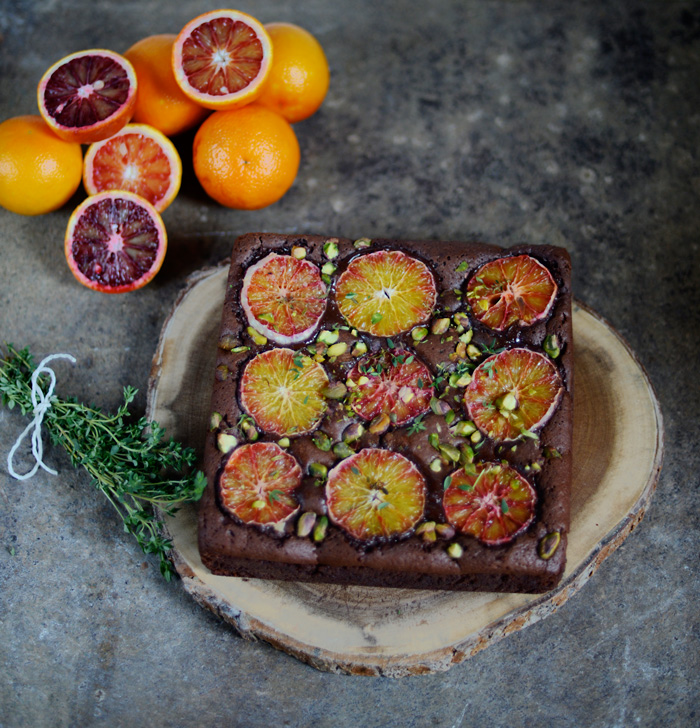
Salty blood orange brownies with pistachios and thyme / Brownies de chocolate, laranja sanguínea, flor de sal, pistachios e tomilho.


Blood oranges are in season now and they are so gorgeous!!
Not just delicious to eat on their own and to juice, but also fabulous to make beautiful desserts and even savoury dishes.
This recipe is from Aimee, "Twigg Studios" gorgeous blog and as soon as I saw it on instagram I had to make it of course.
ingredients:
5 medium eggs
300g dark chocolate (70% cocoa)
300g unsalted butter
400g caster sugar
80g cocoa powder
130g self raising flour
70g plain flour
50g nuts, chopped (I only used pistachio nuts)
1 tsp vanilla extract
sprinkling sea salt flakes
zest of one blood orange
3 tbsp blood orange juice
slices of one blood orange, skin removed
sprigs of thyme


method:
Preheat the oven to 180ºC.
Line a rectangle or square brownie tin with baking paper.
Chop the chocolate as finely as you can.
Put the butter, sugar, orange zest and juice and a sprig of thyme in a pan over medium heat and stir gently until melted.
Whisk the eggs in a stand mixer until smooth then add the chopped chocolate.
Remove the sprig of thyme from the buttery mixture and slowly pour the hot butter mixture onto the eggs, while mixing on a medium speed.
Turn the speed up and mix for 3 to 4 minutes, or until the chocolate has melted.
Sift the flours with the cocoa powder together and.
Once the chocolate and melted, add the vanilla extract and then fold in the dry ingredients.
Pour the mixture into the prepared tin.
Place the orange slices on top of the chocolaty mixture.
Sprinkle the nuts over the top, followed by a sprinkle of the sea salt flakes and a few thyme leaves.
Bake for about 20 minutes until the brownie is just a slight wobble in the centre.

__________________

As laranjas sanguíneas estão agora na estação. A estação é curta e há que tirar o máximo partido delas assim que aparecem.
Adoro-as, não só porque são lindas mas também porque são fabulosas para comer ao natural, espremer (fazem um sumo lindo e delicioso) e usar tanto em receitas doces como salgadas.
Como consegui arranjar uma boa quantidade delas, esta foi a primeira receita que fiz este ano (procurem por "laranja sanguínea" aqui no blogue e encontrarão receitas de outros anos).
A receita é do blog lindo da Aimee, o "Twigg Studios" e assim que ela colocou a foto deste brownie no instagram, pronto, estava decidida a primeira utilização a dar ás laranjas "vampiras" como gosto de lhes chamar.
Caso achem que não conseguem arranjar laranjas sanguíneas em Portugal (e por isso adoro o instagram, pois é uma fonte de informação), sei que podem encontrá-las em Campo de Ourique, na Horta do Bairro e sei também que, caso vivam longe, eles enviam encomendas para todo o País (esta informação foi a Inês que passou a mim e ao Célio). Passo a publicidade, pois não recebi nem vou receber nada em troca, mas gosto que saibam que podem encontrar as laranjas.


ingredientes:
5 ovos médios
300g chocolate preto (70% cacau)
300g manteiga sem sal
400g açúcar refinado branco
80g cacau em pó
130g farinha de trigo branca com fermento
70g farinha de trigo branca
50g frutos secos, picados (eu só usei pistachios)
1 colher chá de extracto de baunilha
uma pitada de flor ou flocos de sal, para polvilhar
raspa de 1 laranja sanguínea
3 colheres sopa de sumo de laranja sanguínea
rodelas de laranja sanguínea, descascadas
hastes de tomilho


preparação:
Aquecer o forno a 180ºC.
Forrar com papel vegetal uma forma quadrada ou rectangular.
Picar o chocolate o mais finamente possível.
Num tacho sobre lume médio, colocar a manteiga, o açúcar, a raspa e o sumo da laranja e uma haste de tomilho. Aquecer, mexendo, até a manteiga estar derretida e o açúcar dissolvido.
Bater os ovos na taça da batedeira eléctrica até estes estarem com uma textura fofa.
Adicionar o chocolate picado aos ovos batidos.
Retirar a haste de tomilho da mistura da manteiga e descartá-la.
Com a batedeira em velocidade média, adicionar a mistura da manteiga quente em fio, à mistura dos ovos e do chocolate.
Aumentar a velocidade da batedeira e continuar a bater por mais 3 ou 4 minutos, ou até o chocolate estar completamente derretido.
Entretanto, peneirar as farinhas e o cacau em pó.
Quando vir que o chocolate está completamente derretido, adicionar o extracto de baunilha à mistura, logo seguido pela mistura das farinhas e cacau e envolver tudo muito bem até estar completamente incorporado.
Colocar a mistura na forma e cobri-la com as rodelas da laranja.
Polvilhar com os frutos secos, a flor de sal e umas folhinhas de tomilho.
Levar ao forno por 20 minutos, ou até, quando abanar a forma, o brownie estar ligeiramente mole no centro.


Recipe / Receita: Aimee - Twigg Studios blog.