Showing posts with label Puff pastry / Massa folhada.. Show all posts

28 October 2017

Fig & Rose Millefeuille / Mil Folhas de Figos e Rosas.


You all know I love a good millefeuilles right?
To me, Millefeuilles are like Pavlovas! Can't see one new recipe of either of them, and you'll spot me running into the kitchen to make it straightaway!
In this post, you can see the list of all the homemade millefeuilles I've already made until today and, this one, with all these exotic and Persian flavours, couldn't go unnoticed and not being part of my millefeuilles list, right?
This is another great recipe from Sabrina Ghayour beautifully gorgeous "Feasts" book and it was so, so delicious that I had to share it with you all.
Try it and thank me later because you will be delighted :))).

20 August 2017

Millefeuilles with Vanilla Crème Pâtissière & feathered Fondant Icing / Mil Folhas com Creme Pasteleiro de Baunilha, decorados com Icing Fondante.


This month and for th 20th edition of the Sweet World, we're asking you to make Millefeuilles.
Millefeuilles are a classic French pastry that consists of layers of puff pastry and cream filling.
Millefeuilles means one thousand sheets, layers, or leaves and they're an old school French pastry that's airy, crispy, flaky, decadent and moreish, in all the right places.
The very first recipe for a millefeuille appeared in François Pierre La Varenne's cookbook in 1651.
Officially, a gâteau millefeuille is constructed of three layers of puff pastry and stabilized pastry cream (mixed with a little gelatin for a tighter cream that's not too runny), decorated with fondant and garnished with a chocolate spider web design on top.
Sometimes mixed up, a millefeuille is not the same as a Napoleon, an Italian dessert where almond paste - similar to frangipane - is sandwiched between its many layers.
Apart from making your own puff pastry instead of using shop bought pastry, a millefeuille is not difficult to make. Actually, if you already mastered how to make a good crème pâtissière, there's nothing to worry about.
So, are you up for the challenge and will you joint us and bring us some gorgeous millefeuilles?
If yes, here are the rules:
  • You have until the 20th of September to make and publish your millefeuilles. 
  • That same day, 20th of September, Susana will let you know in her blog, the theme for the 21th edition of the Sweet World.
  • You'll have to leave your Millefeuilles link here, in this post, in order to be featured in the monthly round up that will be published here on the blog, on the 25th of September.
The recipe I chose, is this one that I'm leaving you today and it's from Lorraine Pascale absolutely gorgeous book "Bake"!
In case you need inspiration to make your millefeuilles, there's a few recipes here on the blog (here, here, here and here).
As for the puff pastry, I always make this recipe but there's this one too, which is simpler to make and will be perfect for your millefeuilles.

30 May 2017

Carrot Tarte Tatin / Tarte Tatin de Cenoura.


Looking for recipes featuring carrots for this month's "Marta and her Ingredient of the Month", I found this fabulous Tarte Tatin where the carrots are the star of the show!
I have to tell you that this tatin was a very, very pleasant surprise as it's so, so flavoursome and delicious that we all loved it to bits.
Of course, homemade pastry helps a lot too and that's the one I used but, saying that, be my guest if you want to use shop bought puff pastry.
The recipe is from Rachel Khoo "Little French Kitchen" book and let me tell you that, it was the first time I made it but, it will not be the last one for sure!!

10 April 2017

Bakewell Tart / Tarte Bakewell.


Bakewell tart!
Something that I wanted to make for a long time but never made!
Although I already tried lots of them (shop bought ones), I was dying to try an homemade one and it doesn't take much but the Sweet World to challenge me to make my own homemade version.
It looks rustic, it looks simple, it doesn't look perfect but, does it taste damn good? Oh yes!!! The best!!
There's lots of controversy around this tart. Its origins, the pastry, the kind of jam, the filling so, everything is uncertain but the thing is: Its a delicious tart indeed!!
I found all the controversial information here, here and here and if you're interested, you can read it all and take your own conclusions.
After doubting and reading lots of recipes, I decided to make this one.
Using puff pastry for the base, Morello cherry jam for the jam layer and frangipane for the top layer, this tart went down a storm and without a doubt, beats any shop bought one that I tasted before!
The recipe, from The Great British Bake Off - Big Book of Baking.
It is a stunner and a treat to be made over and over again whenever there's a craving for these almondy flavours.

5 April 2017

Red Velvet Napoleons with Raspberries / Mil Folhas de Veludo Vermelho e Framboesas.


You know I can't resist a millefeuille recipe right?
Here o the blog, you can find 3 millefeuilles recipes (here, here and here) and each one, better than the previous one!!
So, as soon as I got Lorraine Pascale new book "Bake", I couldn't resist but make this millefeuilles straightaway!
The book is amazing!! Full of delicious recipes and I have lots of them already marked down to be tried.
As for this one, as expected, the millefeuilles were a true delight and a true winner and you should tried it!
Not the healthiest recipe, as you can notice by the ingredients list, but surely, a treat!!


Notes:
  • Of course, I made my own homemade puff pastry, but of course, you can use shop bought puff pastry if that makes you more comfortable.
  • Filling wise, the full fiiling recipe is too much for this recipe so, I advise you to make only half the quantity of the filling because it will be more than enough.

27 July 2016

London Fog Millefeuilles / Mil Folhas "Nevoeiro de Londres".


Those who follow my instagram account (here and here), know very well that I'm very proud of the lavender bush that I have in my garden.
I love lavender, both, the smell and the flavour and every Summer I'm delighted with its beautiful purple shades and the way it comes back to life. Something else I love, is watching all the busy bees always around it.
This recipe, was marked for this time of the year - when my organic lavender is at its best - since the day I bought the fabulous Aimee Twigger "Love, Aimee x" book. A book that you all know I truly adore and from which, this one is the third recipe I'm making (the other two are here and here).
Aimee calls this recipe the London Fog Millefeuilles as, according to Aimee, the millefeuilles flavours were inspired by a London Fog Latte, which is flavoured with Earl Grey tea. Her favourite kind of tea and mine too I have to add.
Aimee perfumed the millefeuilles with the Earl Grey tea and lavender as she thinks they go really well together and I totally agree with her. It's a delightful combination!
I made these millefeuilles last week, for my husband's birthday and they were a huge success.

15 July 2016

Simmone Logue Cornish Pasties / Pasteis de Cornwall da Simmone Logue.


Known and loved throughout Great Britain and Ireland, Cornish Pasties got its name after Cornwall. Arguments abound to the origins of Cornish Pasties with neighbouring Devon claiming to the origins of the pasty.
Whatever the origins, a Cornish Pasty recipe is delicious, easy and fairly quick to make.
It is generally believed that the pasty evolved for Cornish tin miners, who, unable to return to the surface at lunchtime had a hearty, easy to hold and eat, lunch dish.
With their hands often dirty from a mornings work, the pasty could be held by the thick pastry crust without contaminating the contents. The thick crust also acted as an insulator, keeping the contents warm for several hours.
Pasties were often also made with a meat filling at one end and a sweet filling of fruit or jam at the other - a complete meal in one!
While there are no set ingredients of the Cornish pasty, traditional recipes will always use minced or diced steak, onion and potato wrapped in shortcrust pastry.
Variations include the addition of swede or carrots, even peas but a Cornishman will tell you these are not the genuine article (font).
This specific recipe is from Simmone Logue beautiful book "In the kitchen" (you can read more about the book here, here and here) and it's her take on one of her childhood memories.
Although its not the original Cornish Pasty, it's absolutely divine and a pleasure to nibble on.


11 September 2015

Homemade Puff pastry / Massa folhada caseira.

Proper homemade pastry might be time consuming but it's not something that a food or a cook lover shouldn't be able to do.
People tend to say that puff pastry is a pain and that is not worth making it at home. I totally disagree with that. It might be challenging but if you love to cook and specially if you have a food blog, you should be able to make your own puff pastry at home and don't tell me that shop bought puff is equally good because that is something totally unacceptable to say. Especially for a foodie or food blogger.
In this post I left the step by step to make a quick puff pastry which is easy and much better than any shop bought one and today I leave you the step by step on how to make the proper and totally exquisite puff pastry.
As you can see on the pictures, my "squares" and "rectangles" are quite rough but the idea is there and these little imperfections are the charming and delights of homemade stuff.
The less and quickest you work the pastry the better as it is the marbled effect of the butter that will make the pastry puff and laminate.
Up for a challenge? Lets do it then!
Once you make the pastry, you can use it straight away or freeze it and use whenever you want.
ingredients:
250g plain flour
250g butter, chilled
1tsp salt
1tsp lemon juice
130ml very cold water
method:
Sift the flour and salt into a large bowl.
Dice 30g of the butter (keeping the rest chilled) and rub it in the flour to make fine breadcrumbs.
Stir in the lemon juice and the water.
Mix and knead everything together until you have a fairly soft and smooth dough 1️⃣.
Wrap the dough in clingfilm and chill it for about 20 to 30 minutes.
Using a rolling pin, shape the rest of the butter into a square about 13cm and then put it back in the fridge 2️⃣.
Roll out the dough on a lightly floured surface to a square about 20cm 3️⃣.
Put the square of butter in a diamond shape, in the middle of the square of pastry 4️⃣.
Fold each corner of the pastry up and over the butter to enclose it completely 5️⃣.
Turn the pastry over, so the "envelope" shape is now on top of the floured board 6️⃣.
Roll the pastry into a rectangle about 40cm x 12cm 7️⃣, then fold the bottom third up over the dough and the top third down to give you a square with an envelope shape. Seal the edges by pressing down on them with the rolling pin 8️⃣.
Repeat the step above one more time and then wrap the pastry in clingfilm and chill for 20 minutes.
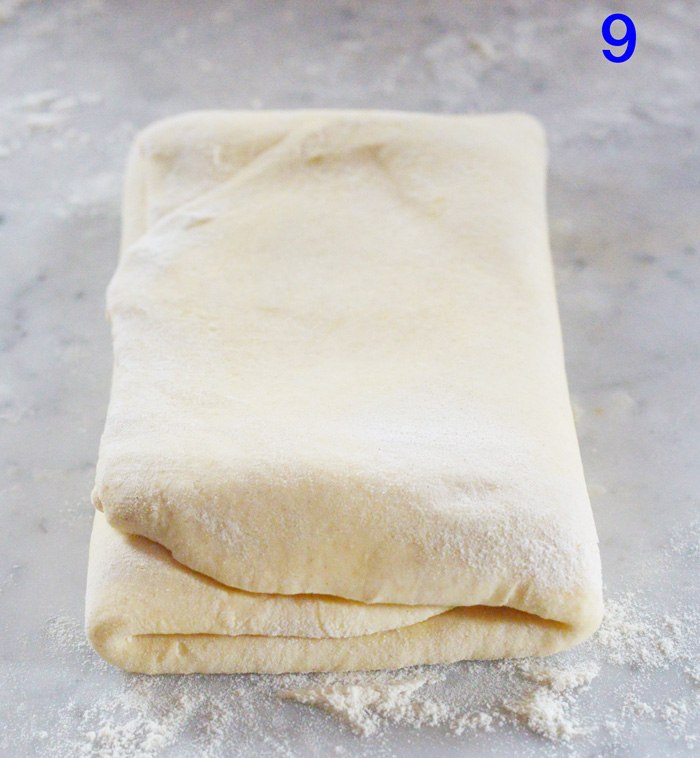
Repeat the rolling and folding steps another 4 times, which will give you 6 turns in total, chilling the pastry for 20 minutes in between every two rollings 9️⃣.
After the final rolling and chilling, the pastry is ready to use 1️⃣0️⃣.
Keep it chilled until necessary.


Massa folhada caseira!
O post de hoje é um passo a passo (o melhor que consegui preparar) de como fazer massa folhada caseira.
Muitas vezes ouço dizer que "massa folhada dá muito trabalho", "não vale a canseira" e, pior que isso, ouço dizer que a "massa folhada de compra é tão boa como a caseira".
Estas frases deviam ser interditas quando proferidas por pessoas que têm blogues de culinária!
Um verdadeiro foodie, alguém que gosta de cozinhar e tem um blogue de culinária, nunca deveria proferir ou sequer pensar em frases como as acima citadas.
Massa folhada não é o bicho papão! Demora o seu tempo a preparar, as primeiras vezes pode correr mal (e olhem que a mim correu mal umas quantas vezes), mas depois de se lhe apanhar o jeito, garanto-vos que  acaba por ser um processo mecânico e automático.
Neste post deixei-vos o passo a passo de como fazer a chamada "massa folhada rápida". Uma massa cujos resultados finais são excelentes e que, para quem não quiser "perder" tanto tempo é uma fantástica opção e olhem que até esta "versão rápida" é bem melhor que a de compra!
O segredo da massa folhada é ter sempre tudo bem frio, ingredientes, mãos e bancada e ser o mais rápido possível a fim de evitar que a manteiga amoleça.
Hoje deixo-vos o passo a passo para fazer a verdadeira massa folhada. A famosa, a de que os franceses tanto se orgulham e com muita razão, pois é algo de absolutamente genial a todos os níveis!
Quando nas explicações falo em "rectângulos" e "quadrados", muitos de vós perceberão que os meus quadrados e rectângulos não são uma coisa nem outra, mas o importante é que vocês percebam a ideia e a imperfeição das formas geométricas e dos cantos todos certinhos, são onde reside o charme do "homemade".
Quanto mais rapidamente e menos trabalharem a massa melhor, pois é o marmoreado da manteiga que no final fará com que a massa lamine e fique folhada.
Deixo-vos só o passo a passo para a massa e daqui a uns dias uma receitinha bem deliciosa para a utilizar.
Então? Vamos fazer massa folhada caseira?
ingredientes:
250g farinha de trigo branca
250g manteiga, bem gelada
1 colher chá de sal fino
1 colher chá de sumo de limão
130ml água bem gelada
preparação:
Peneirar a farinha e o sal para uma taça grande.
Cortar 30g da manteiga em cubos pequeninos (mantendo o restante bloco de manteiga no frigorífico).
Esfregar os 30g de manteiga em cubos na farinha, por forma a obter uma mistura com a consistência de areia fina.
Adicionar o sumo do limão e a água e amassar, por forma a obter uma bola de massa suave e macia 1️⃣.
Embrulhar a bola de massa em película aderente e refrigerar por 20 a 30 minutos.
Entretanto, com o rolo da massa e enfarinhando a bancada e o rolo, bater o restante bloco de manteiga, até obter um quadrado com cerca de 13cm. Limpar a farinha em excesso do quadrado da manteiga, colocá-la num prato e refrigerar até ser necessária 2️⃣.
Sobre uma superfície ligeiramente enfarinhada, esticar a bola de massa, até obter um quadrado com cerca de 20cm 3️⃣.
Colocar o quadrado de manteiga sobre a massa mas na diagonal, ou seja, em forma de diamante 4️⃣.
Dobrar os quatro cantos da massa sobre a manteiga (formato envelope), por forma a que a manteiga fique completamente escondida 5️⃣.
Virar a massa com o lado do "envelope" virado para baixo 6️⃣ e esticar a massa em movimentos seguros e rápidos, até  obter um rectângulo com cerca de 40cm x 12cm 7️⃣.
Com o lado mais estreito da massa virado para si, dobrar o terço inferior da massa para cima e o terço superior da massa para baixo e por cima do anterior, por forma a obter novamente um quadrado 8️⃣.
Selar as extremidades, pressionando-as ligeiramente com o rolo da massa.
Voltar a esticar em rectângulo, a dobrar como no passo anterior e a selar as extremidades uma vez mais. Nesta altura, a massa já tem 2 voltas.
Embrulhar em película aderente e refrigerar por 20 minutos.
Depois de refrigerada por 20 minutos, repetir o passo anterior mais 2 vezes, ou seja, mais 4 voltas, refrigerando por 20 minutos a cada 2 voltas 9️⃣.
Findo este processo, a massa está pronta a usar ou, caso queiram, a congelar para ser utilizada mais tarde 1️⃣0️⃣.

Recipe / Receita: Lia - Lemon & Vanilla.

15 April 2015

Almond and strawberry cruffins / Cruffins de amêndoa e morango.


The first time I heard about the new trendy hybrid bakes was last month in Paris.
I went to Paris with my sister and niece and they were raving over a cronut that they bought at Les Halles while I was enjoying my very first Canelé Bordelais.
This cruffin recipe (croissant + muffin) comes in this month Good Food magazine and I couldn't resist to try it.
It is totally worthy as this new hybrid is absolutely delicious, light in texture and very easy to make.
ingredients for the pastry (makes 6):
1 tsp dried yeast
1 tsp lemon juice
225g strong white flour, sifted, plus extra for shaping
25g golden caster sugar
140g cold unsalted butter, cubed
method:
Measure 75ml just warm water. Add the yeast and stir to dissolve.
Measure another 75ml ice cold water and add the lemon juice to it.
Mix the flour and sugar with 1/2 tsp fine salt in a large bowl.
Toss in the cubed butter until coated in the flour.
Splash with the yeast water and lemon water and using a round bladed knife, work quickly to bring the mixture to a rough dough with lumps of butter held inside it.
Turn onto a floured surface, shape into a rectangle without kneading it too much, then wrap in clingfilm and chill for 15 minutes in the freezer.
Dust the work surface and pastry with flour.
Roll the pastry in one direction until you have a 45 x 15cm rectangle.
Fold the pastry over itself. Fold the bottom third up, then the third top down, to make a neat block.
Turn the block so that its open edge facing to the right, like a book.
Press the edges together gently with the rolling pin.
Roll out and fold the pastry like this 3 more times to make a smooth dough, with the odd streak of butter here and there.
Wrap the finished dough and chill for at least 1 hour.
for the filling:
50g unsalted butter
50g golden caster sugar
50g ground almonds
1 tsp plain flour
a few drops of almond extract
1 egg yolk
method:
Beat together all the ingredients and season with a pinch of salt. Set aside until needed.
to finish:
seedless raspberry or strawberry jam
icing sugar, to dust
to shape:
Put the dough on a floured surface.
Roll the dough onto a rectangle and then cut it into 6 strips, each 10cm wide.
To create even more layers, fold each strip in half lengthways.
Put a generous teaspoon of filling at one of the pastry, then roll the pastry around it in a spiral.
Place, cut edge up, into a non stick muffin tin.
Repeat to make 6 cruffins.
Loosely cover with clingfilm and leave to prove at cool room temperature for 2 hours or until the pastry has filled the wells of the tin.
Heat the oven to 190ºC.
Bake the cruffins for 20 to 25 minutes or until risen and deep golden brown.
Remove and cool on a wire rack.
To fill the cruffins with jam, spoon the jam into a pipping bag fitted with a 5mm nozzle. Push the nozzle into the middle of each cruffin and squeeze.
Dust with icing sugar and eat cool or warm.

__________________


A primeira vez que ouvi falar nestes novos "híbridos" da pastelaria foi em Paris.
O mês passado passei lá uns dias com a minha irmã e sobrinha e enquanto, no mercado Les Halleseu provava o meu primeiro Canelé Bordelais, elas estavam felicíssimas a degustar um (ou melhor, dois)  cronuts, croissant + donut.
Fiquei muito curiosa em relação a esta nova combinação da pastelaria e pensei pesquisar sobre o assunto, mas entretanto, na revista Good Food deste mês, vem esta receita para cruffins, ou seja, croissant + muffin!
Bom, nem hesitei em experimentar e só vos posso assegurar que são algo de absolutamente maravilhoso!!
Caso achem os passos da massa complicados, espreitem este post que fiz aqui, pois o processo é, senão igual, muito semelhante.


ingredientes para a massa folhada (para 6 cruffins):
1 colher chá de fermento de padeiro seco
1 colher chá de sumo de limão
225g farinha para pão + extra para a bancada e para esticar
25g açúcar refinado amarelo
140g manteiga sem sal, fria e cortada em cubos
preparação:
Num jarro, medir 75ml de água morna. Adicionar o fermento, mexer bem para dissolver e reservar.
Num jarro à parte, medir mais 75ml de água gelada e adicionar-lhe o sumo do limão. Reservar.
Numa taça, misturara a farinha, o açúcar e 1/2 colher chá de sal refinado.
Adicionar a manteiga em cubos e envolver, por forma a que toda a manteiga fique enfarinhada.
Adicionar a água com o fermento e a água com o limão e, com uma faca de mesa, envolver rápido, sem trabalhar a massa em demasia, por forma a que todos os ingredientes fiquem bem incorporados. A manteiga deverá permanecer praticamente na sua forma original, ou seja, em cubos.
Virar a massa sobre uma superfície ligeiramente enfarinhada e moldar um rectângulo, sem amassar.
Embrulhar a massa em película aderente e colocar no congelador por cerca de 15 minutos.
Polvilhar a bancada, a superfície da massa e o rolo com farinha.
Esticar a massa num só sentido, por forma a obter um rectângulo com aproximadamente 45 x 15cm.
Dobrar 1/3 da massa sobre o centro e o outro 1/3 sobre o primeiro, por forma a obter um bloco de massa.
Virar o bloco de massa por forma a que o lado aberto fique virado para a direita, como se de um livro se tratasse.
Delicadamente, pressionar as extremidades com o rolo da massa, para as unir.
Esticar e dobrar a massa como anteriormente explicado, mais 3 vezes, ou seja, a massa terá sido esticada e dobrada 4 vezes no total. Convém não trabalhar a massa em demasia, para que se possam ver laivos da manteiga aqui e ali, pois são esses laivos que vão produzir as camadas típicas da massa folhada.
Embrulhar em película aderente e refrigerar por, no mínimo, 1 hora.
para o recheio:
50g manteiga sem sal, amolecida
50g açúcar refinado amarelo
50g amêndoa ralada
1 colher chá de farinha de trigo branca
umas gotinhas de extracto de amêndoa
1 gema de ovo
preparação:
Bater os ingredientes todos numa taça, temperar com uma pitada de sal e reservar até ser necessário.
para finalizar:
doce de framboesa ou morango, sem sementes
açúcar em pó, para polvilhar
montagem:
Colocar a massa sobre uma superfície enfarinhada.
Esticar a massa até obter um rectângulo suficientemente grande, por forma a poder cortar 6 tiras com cerca de 10cm de altura cada.
Dobrar cada tira ao meio, no sentido do comprimento, a fim de obter mais camadas folhadas no final.
Colocar uma generosa colher de chá do recheio, na extremidade da massa que se dobrou e enrolar a massa numa espiral à volta do recheio. Repetir o processo para todas as tiras.
Colocar as espirais, lado do corte virado para cima, nos buracos de uma forma de muffins de silicone ou anti aderente (caso não tenham, untem ligeiramente os buracos de uma forma de muffins normal).
Cobrir (sem apertar) com película aderente e deixar levedar à temperatura ambiente, por cerca de 2 horas, ou até a massa ter enchido os buracos da forma.
Aquecer o forno a 190ºC.
Cozer os cruffins por 20 a 25 minutos, ou até estarem bem crescidos e douradinhos.
Retirar da forma e arrefecer sobre uma grelha.
Colocar o doce num saco de pasteleiro ou numa garrafinha de plástico de Chef com um bico de cerca de 5mm de diâmetro.
Introduzir o bico no centro de cada cruffin e rechear com o doce.
Polvilhar os cruffins com açúcar em pó e servir mornos ou frios.

Recipe / Receita: Good Food Magazine - April 2015.

11 March 2015

Rhubarb and custard millefeuilles / Mil folhas de ruibarbo e custard.


I love rhubarb but I tend to not make many things with it as, here at home, rhubarb is loved by ones and hated by others.
My daughter loves it and my husband hates it. My son said he hated it all his life and the last time I made something with rhubarb, he had a fair amount of it and confessed that he loves it but he was saying all the time that he hated it, just to please his daddy... Unbelievable right? I almost strangled him that day, lol!
When I saw a beautiful bunch of a very pink and gorgeous rhubarb last time I went shopping, I couldn't resist and brought it home with me.
Because this Rachel Khoo recipe was one of the many marked down to test, I didn't have to think much about where I was going to use it.
This is a very gourmet dessert that went down a storm as the combination is absolutely scrumptious.
ingredients (serves 4):
375g pack of ready rolled puff pastry, removed from the fridge 20 minutes before using
1 egg, beaten
2 tbsp caster sugar
1 tbsp icing sugar
method:
Preheat the oven to 180ºC and line a baking tray with baking paper.
Cut off the pastry into 12 rectangles measuring 4cm x 10cm and place them on the baking tray.
Brush lightly with the beaten egg and sprinkle with caster sugar. Cover the rectangles with another sheet of baking paper, then place another baking tray on top, to stop the pastry from rising.
Bake for 30 minutes.


for the custard:
3 egg yolks
40g caster sugar
20g cornflour
250ml whole milk
1/2 a vanilla pod, seeds scrapped and pod reserved (I used 1 tsp vanilla paste)
method:
Whisk the egg yolks with the caster sugar for 2 to 3 minutes, or until you have a light and thick mixture.
Whisk in the cornflour.
Bring the milk to the boil with the vanilla seeds and the vanilla pod.
Pour the milk in a slow stream on to the egg mixture, whisking all the time.
Return the mixture to a clean pan and whisk continuously over a medium heat, scrapping down the sides and the bottom of the pan.
Once the cream releases a bubble or two, take it off the heat.
Pour the custard into a bowl to cool to room temperature.
When cooled, spoon it into a large pipping bag with a 1cm nozzle and place in a jug so it stays upright.
Put it in the fridge and chill for 1 to 2 hours.
for the rhubarb:
400g rhubarb, washed, trimmed and cut into 10cm pieces
50g caster sugar
method:
Toss the rhubarb in the sugar and place it in a small baking dish.
Roast at 180ºC for 20 minutes or until the rhubarb is tender but not mushy.
to assemble:
Pipe 2 blobs of custard on a serving plate. Stick a pastry rectangle on top, then place 3 to 4 slices of rhubarb on top of the pastry.
Place another piece of pastry over the rhubarb and pipe 2 lines of custard on this second layer of pastry.
Top with the 3rd rectangle and dust with icing sugar.
Repeat to make 4 millefeuilles and serve immediately.
__________________


Eu adoro ruibarbo mas não faço muitas coisas com ele porque, cá em casa, o ruibarbo é amado por uns e odiado por outros.
Eu e a minha filha adoramos. O meu marido odeia e o meu filho, que passou a vida a dizer que odiava, na última vez que fiz algo com ruibarbo, comeu que se fartou e no fim confessou que adora ruibarbo, mas que sempre disse que odiava para agradar e fazer pandilha com o seu papá... GRRR!! Quase o estrangulei nesse dia..., lol!
Quando, de uma das vezes que fui ás compras, vi um molho lindo de ruibarbo, com um aspecto fabuloso e com uma cor rosa linda, não hesitei em trazê-lo comigo para casa.
Como esta receita da Rachel Khoo, era uma das que estava marcada para fazer desde o início, podem calcular que não tive de pensar muito onde utilizar o ruibarbo certo?
Esta é ums sobremesa linda e que causa impacto em qualquer mesa e a combinação de ingredientes é completamente indescritível e difícil de adjectivar.
ingredientes (para 4 pessoas):
1 rectângulo de massa folhada com 375g, retirada do frigorífico 20 minutos antes
1 ovo, batido
2 colheres sopa de açúcar refinado branco
1 colher sopa de açúcar em pó
preparação:
Aquecer o forno a 180ºC e forrar um tabuleiro grande com papel vegetal.
Cortar a massa folhada em 12 rectângulos de 4cm x 10cm cada e colocá-los no tabuleiro.
Pincelar levemente com o ovo e polvilhar com o açúcar refinado.
Cobrir os rectângulos com uma folha de papel vegetal e colocar outro tabuleiro em cima, a fim de evitar que a massa cresça.
Levar ao forno por cerca de 30 minutos.
para o custard:
3 gemas de ovo
40g açúcar refinado branco
20g Maizena
250ml leite gordo
1/2 vagem de baunilha, sementes raspadas e casca reservada (eu usei 1 colher chá de pasta de baunilha).
preparação:
Bater as gemas com o açúcar por 2 ou 3 minutos, ou até obter uma mistura pálida e espessa.
Adicionar a maizena e voltar a bater.
Colocar o leite num tacho com as sementes e a casca da vagem da baunilha e levar ao lume até levantar fervura.
Lentamente e em fio, adicionar o leite a ferver à mistura das gemas, batendo vigorosamente o tempo todo.
Colocar a mistura num tacho limpo e aquecer em lume médio, mexendo o tempo todo e raspando bem os lados e fundo do tacho, até o creme começar a fazer bolhas. Assim que vir uma ou duas bolhas, retirar do lume imediatamente.
Deitar o custard numa taça para arrefecer até estar á temperatura ambiente.
Quando arrefecido, colocar o custard dentro de um saco de pasteleiro equipado com um bico de 1cm de diâmetro.
Colocar o saco de pasteleiro com o custard dentro de um jarro, a fim de o manter direito e refrigerar por 1 ou 2 horas.
para o ruibarbo:
400g ruibarbo, lavado, pontas aparadas e cortado em pedaços de 10cm
50g açúcar refinado branco
preparação:
Misturar os pedaços de ruibarbo com o açúcar e colocá-los num tabuleiro ou recipiente refractário. Levar ao forno a 180ºC, por cerca de 20 minutos, ou até estar macio, mas sem estar desfeito.
para montar os mil folhas:
Com o saco de pasteleiro, colocar dois pontos de custard nos pratos onde vai servir os mil folhas, a fim de evitar que eles deslizem.
Colocar 1 rectângulo de massa folhada no prato e sobre esta, colocar 2 ou 3 pedaços de ruibarbo.
Cobrir com o 2º rectângulo de massa e, sobre este, desenhar duas linhas de custard.
Cobrir com o 3º rectângulo de massa folhada e polvilhar com açúcar em pó.
Repetir o processo, até ter montado os 4 mil folhas.
Servir imediatamente.

Recipe / Receita:

9 February 2015

Caramelised apple and Camembert tartlets / Tarteletes de maçã caramelisada e Camembert.


Life in a bag is a Portuguese brand that aims to inspire people to grow their own herbs and micro  greens in small spaces at home.
When Alexandra from Life in a bag contacted me asking if I wanted to try one of their products, of course I said yes. Not just because I love herbs and micro greens, but also because I truly admire their work, inovative approach and initiative.
Here you can read more about this fabulous brand and all the products they have to offer and learn a bit about their work.
Concerning this recipe, I'm not going to say that I invented the recipe I'm bringing you today because, as Marco Pierre White wrote in his White Heat book, "anyone who says they have invented a dish is just bullshitting. You'd need to invente new ingredients before you could invent new dishes" and I SO TOTALLY agree with him!!
The only thing I did for this recipe was playing with the classics and apple and cheese are already a classic combination so, I just gave the classic a little twist and it turned out a perfect and delicious meal. As simple as that!
ingredients (serves 4 as a light lunch):
375g puff pastry (I used this homemade one, but feel free to use shop bought pastry),
flour, to dust
1 small egg, beaten
for the filling:
2 Granny Smith apples, peeled, quartered, cored and sliced about 0.5cm thick
2 tsp butter
3 tsp dark brown sugar
1 spring thyme, leaves picked
12 (0.5cm thick) slices Camembert cheese
freshly ground black pepper
white mustard cress, to garnish
method:
Preheat the oven to 180ºC and line a baking tray with baking paper.
Roll the pastry on a lightly floured surface into a 30 x 20cm rectangle.
Cut the pastry into 4  equal rectangles and using a sharp knife, trace a smaller rectangle on the inside of each pastry piece, in order to have a 1cm border. Be careful to not cut all the way through the pastry.
Brush the pastry borders with the beaten egg and refrigerate until required.
To prepare the filling, mix the apples with the sugar and the thyme leaves.
Melt the butter in a frying pan, add the sugary apples and fry, over a medium heat, until the apples are golden brown on both sides. Allow the apples to cool a little before assembling the tartlets.
To assemble the tartlets, cover the pastry rectangles with rows of alternating pieces of apple and cheese slices.
Bake the pastry cases in the preheated oven for 15 to 20 minutes or until golden.
Sprinkle the tartlets with the white mustard cress and a little grind of black pepper and serve them warm, with lightly dressed salad leaves.
__________________


Acho que não preciso de fazer grandes dissertações sobre os produtos Life in a bag, pois acredito que já todos ouviram falar deles.
Quando a Alexandra me contactou perguntando se eu gostaria de experimentar um dos seus produtos, claro que nem hesitei em aceitar, pois é uma marca portuguesa que admiro há bastante tempo e cujo sucesso, iniciativa, trabalho e inovação, são motivo de orgulho para qualquer português a viver no estrangeiro.
No que à receita diz respeito, nem vou ousar escrever que criei ou inventei esta receita, pois como diz o Grande Marco Pierre White e nem me vou dar ao trabalho de traduzir a frase: "anyone who says they have invented a dish is just bullshitting. You'd need to invente new ingredients before you could invent new dishes" e eu, francamente, não podia concordar mais com esta frase, pois é algo que, mais ou menos e nos mesmos termos, venho sublinhando há já bastante tempo.
Bom, não tendo, criado ou inventado nada, limitei-me a brincar um bocadinho com um clássico e a combinação de maçã e queijo é, como sabem, um clássico!!
Aqui vos deixo então esta sugestão onde utilizei as micro ervas de mostarda branca que tão gentilmente me foram oferecidas pela Life in a bag.
ingredientes (para 4 pessoas - para um almoço ligeiro):
375g massa folhada (eu usei esta receita de massa folhada caseira, mas sintam-se à vontade para usar massa folhada de compra).
farinha, para a bancada
1 ovo pequeno, batido
para o recheio:
2 maçãs Granny Smith, descascadas, cortadas em quartos, descaroçadas e cortadas em fatias de cerca de 0.5cm de espessura.
2 colheres chá de manteiga
3 colheres chá de açúcar mascavado escuro
folhas de uma haste de tomilho
12 fatias de Camembert, cortadas em fatias de cerca de 0.5cm de espessura
pimenta preta, moída na altura
micro ervas de mostarda branca, para decorar
preparação:
Aquecer o forno a 180ºC e forrar um tabuleiro com papel vegetal.
Sobre uma superfície ligeiramente enfarinhada  esticar a massa folhada num rectângulo de cerca de 30 x 20cm.
Cortar a massa em 4 rectângulos iguais e dentro de cada rectângulo, a cerca de 1cm da extremidade da massa, utilizando uma faca afiada, cortar uma linha a toda a volta, tendo o cuidado de não cortar a massa até ao fundo, por forma a que cada rectângulo fique com uma bordadura de cerca de 1cm.
Pincelar as bordaduras dos rectângulos de massa com o ovo batido e refrigerar até serem necessários.
Para preparar o recheio, colocar as fatias de maçã numa taça, polvilhar com o açúcar e as folhas de tomilho e misturar bem.
Derreter a manteiga numa frigideira sobre lume médio. Adicionar a mistura das maçãs e cozinhar até as maçãs estarem douradinhas de ambos os lados.
Apagar o lume e deixar as maçãs arrefecer antes de montar as tarteletes.
Retirar a massa do frigorífico e, sobre cada rectângulo, evitando as bordaduras, colocar filas de maça caramelisada  alternadas com fatias de queijo, sobrepondo ligeiramente todas as camadas.
Levar ao forno por cerca de 15 a 20 minutos, ou até as tarteletes estarem bem douradinhas.
Servir as tarteletes mornas, polvilhadas com as micro  ervas de mostarda branca e uma pitada de pimenta preta moída na altura.
Acompanhar com uma salada ligeiramente temperada.

Recipe / Receita: Lia - Lemon & Vanilla.